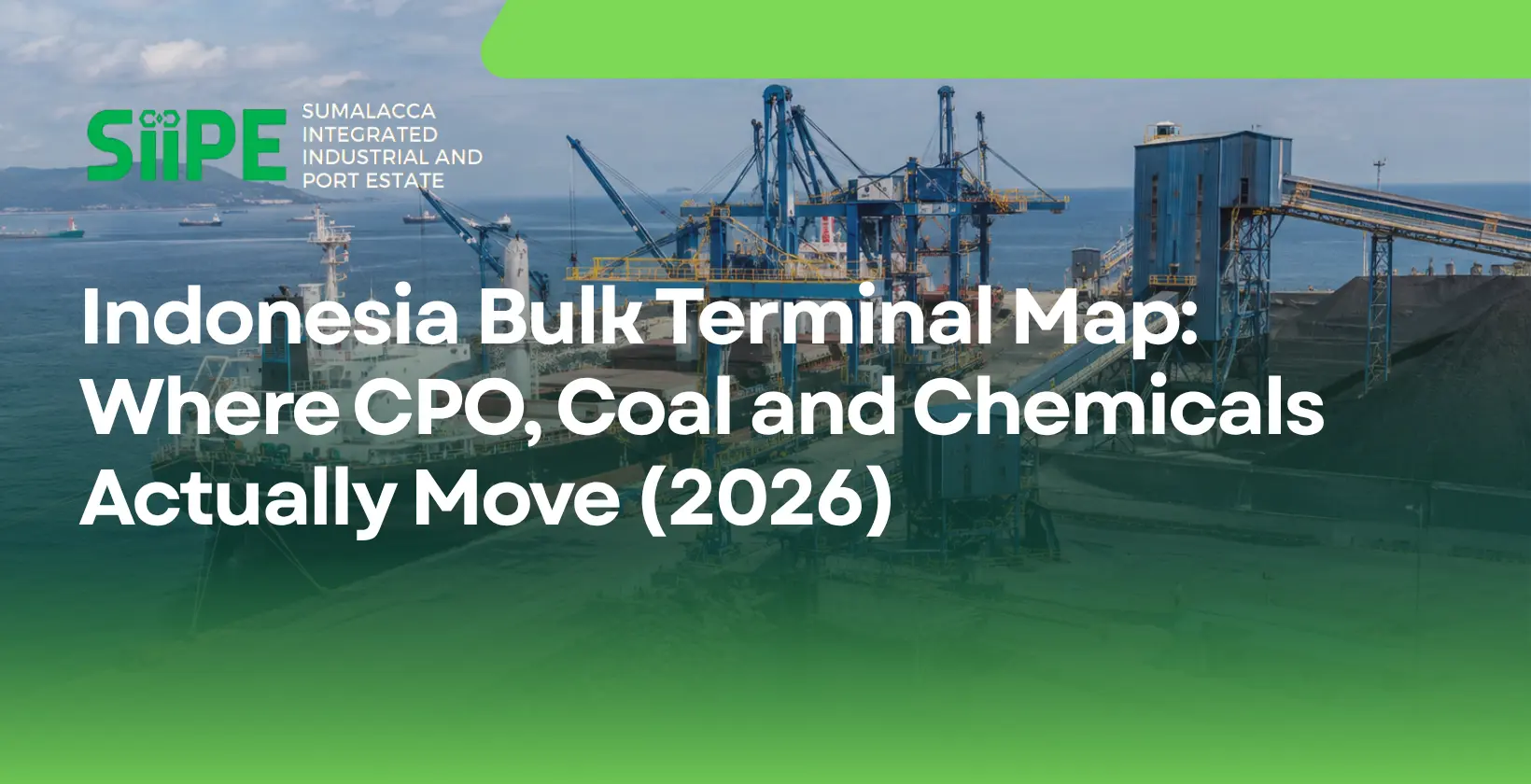
Indonesia bulk terminal is rarely a single place. Palm oil leaves through a handful of Sumatran ports, coal through captive jetties and open-sea anchorages off Kalimantan, chemicals through independent tank farms on the Java side of the Sunda Strait, and grain and ore through one very deep port in Banten. This page maps them by commodity, with the capacities and vessel limits that have been published, so a manufacturer can see where its cargo would actually load.
One note on the name. PT Indonesia Bulk Terminal is also a company: the Adaro group’s coal terminal at Pulau Laut, South Kalimantan. It appears in the coal section below. This page is about the whole network.
We develop an estate in North Sumatra with a bulk port in its masterplan, so the last section is about the gap we are planning into. Every figure carries its year, because Indonesian terminal data is published unevenly.
Last updated: 05 October 2026
How Indonesia’s Bulk Cargo Is Organised
Bulk cargo in Indonesia moves through three kinds of facility, and the kind tells you who sets the tariff, who owns the berth window and how much capacity is really available.
- Public terminals under Pelindo. The state port group’s non-container subholding, Pelindo Multi Terminal (SPMT), runs the liquid and dry bulk berths at the main commercial ports. It handled 22.25 million tonnes of liquid bulk in the first nine months of 2025, up 4.8%, across seven ports: Belawan, Dumai, Teluk Bayur, Surabaya’s Jamrud Nilam Mirah, Tanjung Wangi, Banjarmasin’s Trisakti and Sampit’s Bumiharjo Bagendang. Crude palm oil and its derivatives dominate.
- Captive terminals. Coal miners, nickel smelters, cement plants and steel mills build their own jetties, sized to their own output. The biggest bulk volumes in the country move through these, and third-party access is by negotiation, if at all.
- Independent tank terminals. Storage operators such as Vopak lease tank capacity to chemical, fuel and vegetable oil traders, mostly on Java.
An industrial estate with its own bulk port, which is what SIIPE is planning, sits between the second and third model: a berth owned by the estate, shared by its tenants. Our guide to bulk terminal operations explains what happens on the quay.
Liquid Bulk: The Palm Oil Gateways
Indonesia exported 32.34 million tonnes of palm oil products in 2025, according to GAPKI, and most of the crude and refined oil leaves through Sumatra, where the plantations are. Four ports carry the load.
| Port | Operator | What is published | Year |
|---|---|---|---|
| Dumai, Riau | Pelindo (SPMT) | Indonesia’s largest CPO export port: 4.28 million tonnes of CPO worth US$3.72 billion; liquid bulk wharf 800 m outer and 400 m inner for barges, dry bulk wharf 700 m | 2023 |
| Belawan, North Sumatra | Pelindo (SPMT) | Dedicated liquid bulk terminal for CPO and derivatives, capacity 6 million tonnes a year, exports running at 3.5 to 4 million tonnes, mainly to China and Japan; tank-to-ship by pipeline | 2025 |
| Teluk Bayur, West Sumatra | Pelindo (SPMT) | 3.1 million tonnes of palm products exported, total export value Rp42 trillion; refiner Apical added 1 million tonnes of capacity | 2025 |
| Kuala Tanjung, North Sumatra | Pelindo | Berth 500 m at -16 m LWS for vessels to 100,000 DWT; liquid bulk capacity 1.2 million tonnes a year, containers 400,000 TEU | 2024 |
Dumai’s status comes from the Dumai trade office figures reported by ANTARA, which name the SPMT Dumai branch as the country’s largest CPO exporter. Belawan’s numbers are from the SPMT Belawan branch manager, speaking in March 2025. Kuala Tanjung’s specification is from Pelindo’s announcement of its logistics hub, which also lists a 57-hectare industrial estate beside the port and a tank-storage partner for bulk transhipment.
One thing the table does not show: the figures are per port, not per berth. At each of these ports the liquid bulk berth is shared by every tank-farm operator behind it, so the published capacity is a ceiling on the whole port, not a promise to any one shipper. Our guide to sustainable palm oil in Indonesia covers what segregated, traceable oil demands of those shared tanks.
If you are placing a refinery, oleochemical or biodiesel plant and want to see the berth it would use before you see the plot, book an investor call and we will walk you through the planned port and the status of every component.
Chemicals and Fuels: Independent Tank Terminals
Chemical cargo in Indonesia clusters where the petrochemical plants are: the Banten coast around Merak and Cilegon, and Jakarta’s Tanjung Priok. Independent storage is the model here rather than a public berth.
Vopak’s Merak terminal, acquired with 76,900 cubic metres of chemical storage and described by the company as sitting in one of the country’s petrochemical hubs, handles imported liquid chemicals for storage and transhipment. Vopak’s Jakarta terminal, a joint venture with AKR, opened its first 250,000 cubic metres for petroleum products in 2009.
Outside Java the position is different. Sumatra has palm oil tankage in quantity and very little independent chemical storage, so a speciality chemical or oleochemical plant in North Sumatra usually builds its own tanks and depends on the public liquid bulk berth at Belawan for the ship. That dependency is why our masterplan pairs chemical plots with liquid bulk handling and storage inside the estate.
Coal: Captive Terminals and Anchorages
Coal is the largest bulk cargo Indonesia moves, and almost none of it passes through a public terminal. The miners built their own.
| Facility | Owner | Capacity and vessel limit | Year |
|---|---|---|---|
| Tarahan, Lampung | PT Bukit Asam | 25 million tonnes a year after the 2015 expansion; ships to 210,000 DWT; rail from Tanjung Enim | 2015 |
| Pulau Laut (PT Indonesia Bulk Terminal), South Kalimantan | Adaro group | 12 million tonnes a year; 200,000 DWT bulk carriers; opened 1997 | 1997 |
| North Pulau Laut Coal Terminal, South Kalimantan | PT Arutmin Indonesia | About 13.2 million tonnes a year; Handymax to Capesize, up to 150,000 DWT | 1994 |
| Taboneo anchorage and Banjarmasin, South Kalimantan | Open-sea loading point | 94.8 million tonnes of coal loaded in 2023, up from 78.1 million in 2022 | 2023 |
| Cigading International Bulk Terminal, Banten | MTD group | 7.5 million tonnes a year, coal | 2011 |
The figures are from Global Energy Monitor’s coal terminal tracker; its Tarahan entry records Sumatra’s one large coal terminal, fed by rail rather than barge.
The Taboneo line is the one to understand. Most Kalimantan coal does not load at a terminal at all: it travels by barge down the rivers to open-sea anchorages, where floating cranes transfer it into ocean-going bulk carriers. That is why one anchorage off Banjarmasin outloads several times the volume of any built terminal in the country, and why the coal model is not one a manufacturer can borrow. Anchorage loading suits a cargo that tolerates weather delay and needs no storage at the water’s edge. Palm oil, chemicals and cement do not.
Dry Bulk Imports: Grain, Ore and Clinker
Dry bulk imports, meaning grain and meal for food and feed, ore and scrap for steel, and clinker and gypsum for cement, concentrate at one port. Krakatau International Port at Cigading, operated by PT Krakatau Bandar Samudera, describes itself as the biggest and deepest dry bulk port in Indonesia, receiving vessels from 10,000 to 200,000 DWT and handling coal, clinker, cement, gypsum, iron ore, slag, limestone, manganese ore, silica and grain. The rest of the country’s dry bulk arrives at the general-purpose berths of the main Pelindo ports, or at the captive jetties of the plants that consume it.
Nickel is the captive case at its largest. The Morowali industrial park in Central Sulawesi, 2,000 hectares of smelters and stainless steel mills, is served by its own seaport and power plant, and its ore, coal and product never touch a public terminal. Heavy industry that depends on bulk cargo builds the berth itself if nobody else has.
In Sumatra, cement, fertiliser and feed inputs come through the multipurpose berths at Belawan, Dumai and Teluk Bayur, competing for quay time with palm oil and containers.
The Sumatra Gap
Put the liquid bulk table beside the coal table and the imbalance is plain. Sumatra holds the plantations, but its palm oil export capacity rests on a few public berths, and the one serving the Medan industrial belt is running close to its rated capacity. Belawan’s liquid bulk terminal is rated at 6 million tonnes and already handles 3.5 to 4 million; in February 2026 a member of the national legislature’s finance commission called for the port to be deepened from 14 m to more than 18 m. Kuala Tanjung has the depth, at -16 m LWS, but its liquid bulk capacity is 1.2 million tonnes and it sits 43 km from the Sei Mangkei economic zone and further from Medan. Our comparison of Kuala Tanjung and Belawan goes through that trade-off.
Refineries, oleochemical and food plants cluster between Medan and Belawan, and they reach the ship by pipeline through shared tank farms or by truck through the port gate. The gap is not tonnage alone. It is the absence of a bulk berth a processor can plan its plant around, inside the estate where the plant stands.
SIIPE (Sumalacca Integrated Industrial and Port Estate) is our answer to that gap, and it is a plan rather than a port. The estate is a planned 5,600-hectare integrated industrial estate, deep seaport and township in Medan Belawan, 4.7 km from the Port of Belawan. Around 840 hectares is acquired and the remaining 4,760 hectares still has to be acquired or reclaimed. The current development phase covers 3,000 hectares: 1,800 ha industrial estate, 400 ha deep seaport and 800 ha residential township.
The Sumalacca Dry & Liquid Bulk Port is planned, not operational, and it is a medium-term objective on our roadmap. Its published design is a basin of -8 to -10 m LWS with a 13 nautical mile approach channel to the Strait of Malacca, which suits Handysize and smaller Supramax vessels rather than the Capesize ships the coal terminals above receive. No berth count, tank capacity or throughput figure has been published, and we will not invent one. What the plan does fix is distance: plantation processing, chemical and dry bulk plots designed to sit under 5 km from the estate’s own berth, with customs and quarantine services planned on site.
That is the trade a processor is assessing: Belawan’s shared berth a few kilometres away today, and a dedicated one, shallower but adjacent, when the plan is built.
Frequently Asked Questions
What is the largest bulk terminal in Indonesia?
By volume on this map, the Taboneo anchorage off Banjarmasin, which together with the port loaded 94.8 million tonnes of coal in 2023. Among built terminals, Bukit Asam’s Tarahan coal port in Lampung is rated at 25 million tonnes a year, and Krakatau International Port at Cigading calls itself the country’s largest and deepest dry bulk port.
Which Indonesian port handles the most palm oil exports?
Dumai in Riau. The Dumai trade office reported 4.28 million tonnes of crude palm oil exports worth US$3.72 billion in 2023, and Pelindo’s SPMT Dumai branch is named as the country’s largest CPO exporter. Belawan follows at 3.5 to 4 million tonnes a year, then Teluk Bayur at 3.1 million tonnes in 2025.
What is PT Indonesia Bulk Terminal?
PT Indonesia Bulk Terminal (IBT) is the Adaro group’s coal terminal at the southern tip of Pulau Laut, South Kalimantan. Opened in 1997, it is rated at 12 million tonnes a year and can load bulk carriers of 200,000 DWT. It also hosts a fuel terminal operated with Shell.
Does Sumatra have a deep-water bulk terminal?
Partly. Kuala Tanjung in North Sumatra has a 500 m berth at -16 m LWS for vessels up to 100,000 DWT, but only 1.2 million tonnes of liquid bulk capacity. Belawan handles most of the region’s palm oil at 14 m depth, and Tarahan in Lampung loads coal onto ships up to 210,000 DWT.
Is the Sumalacca bulk port at SIIPE operational?
No. The Sumalacca Dry & Liquid Bulk Port is planned, not built, and is a medium-term objective on the SIIPE roadmap. Its published design is a basin of -8 to -10 m LWS with a 13 nautical mile approach channel, suited to Handysize and smaller Supramax vessels. No berth or throughput figure has been published.
Talk to SIIPE’s Investment Team
If your plant depends on a bulk berth, the questions to settle are its depth, its distance from your tanks, and who else shares it. SIIPE is a planned 5,600-hectare estate in Medan Belawan with a current 3,000-hectare development phase, around 840 hectares acquired, and a site 4.7 km from Belawan Port. Its port and utilities are planned rather than operational, and we will say so in every meeting.
Our investment team can take you through the plots reserved for plantation processing, chemicals and dry bulk, the planned port’s design, and the status of each permit. Book an investor call through the enquiry form, or message us on WhatsApp at +62 811 860 980.