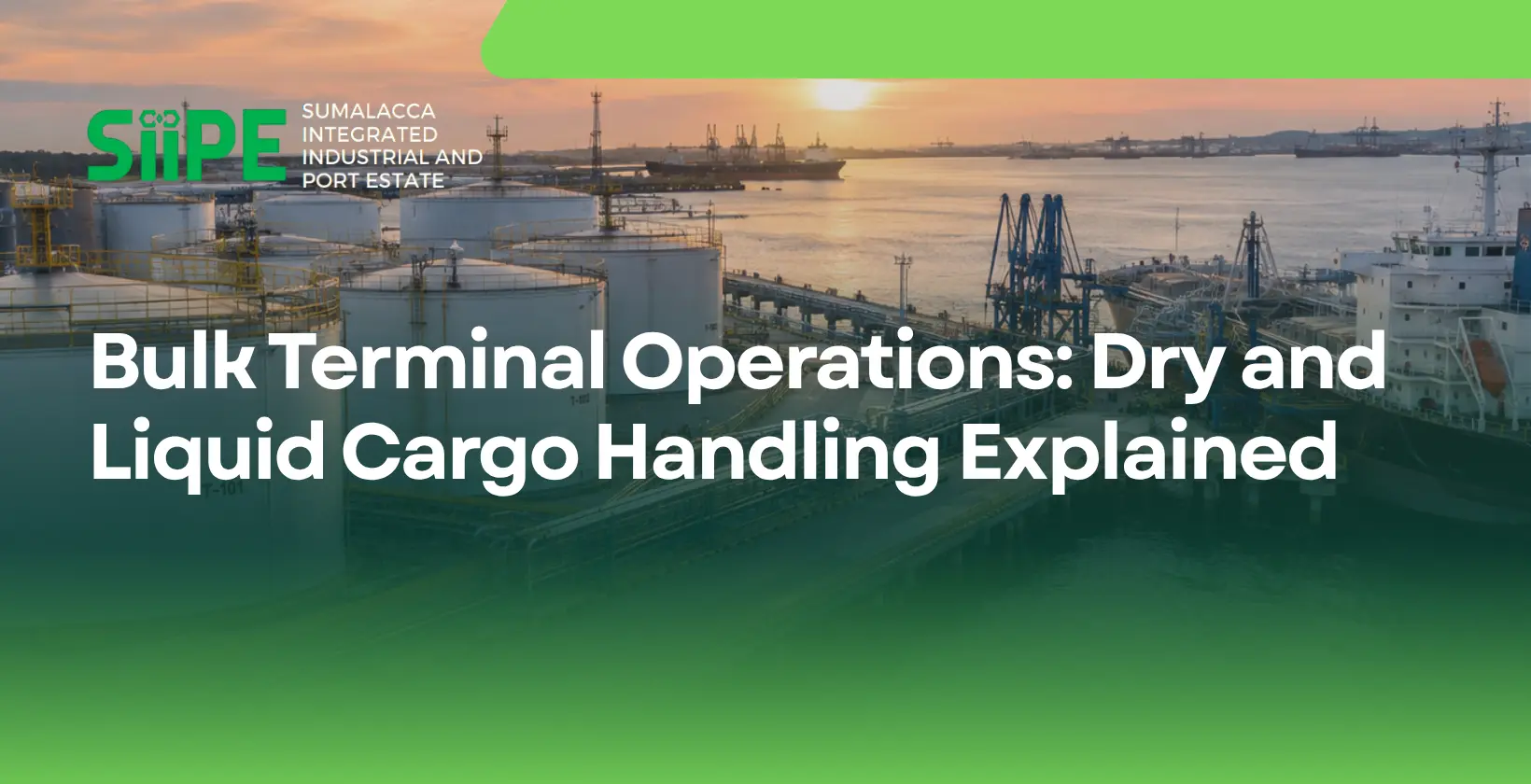
A bulk terminal moves cargo that has no packaging: coal, cement, fertiliser and grain on the dry side, crude palm oil, chemicals and fuels on the liquid side. Because nothing is boxed, the terminal’s equipment is the packaging, and its design decides how fast a ship turns around, how much product is lost on the way to storage, and what a tonne costs to move across the quay.
This guide explains how a bulk terminal works, on both the dry and liquid side: the handling chain from berth to storage, the machines that do the work, how throughput and berth productivity are measured, and what a manufacturer inside an integrated estate should ask about the terminal it will depend on.
Last updated: 23 September 2026
What a Bulk Terminal Is
A bulk terminal is a berth, a transfer system and a storage area built around cargo that is poured, pumped or conveyed rather than lifted in units. It sits at the other end of the spectrum from a container terminal, where every box is the same shape and the crane does not care what is inside.
Bulk cargo is most of what moves by sea. Global maritime trade reached 12,720 million tonnes in 2024, up 2.2 percent, according to UNCTAD’s Review of Maritime Transport 2025, and the majority of that tonnage is dry and liquid bulk rather than containers.
The two families share a berth but almost nothing else. The table shows how they differ.
| Dry bulk terminal | Liquid bulk terminal | |
|---|---|---|
| Typical cargo | Coal, iron ore, grain, cement, clinker, fertiliser, copra residue | Crude palm oil, refined oils, chemicals, fuels, LPG |
| Ship-to-shore transfer | Grab cranes, continuous unloaders, shiploaders | Marine loading arms or hoses at a jetty manifold |
| Transfer to storage | Belt conveyors, pneumatic lines, trucks | Pipelines, pumps, heated lines for some products |
| Storage | Open stockpiles, covered sheds, silos | Tank farms with product segregation |
| Main losses | Dust, spillage, degradation in the open | Contamination, vapour, temperature damage |
The Port Economics, Management and Policy reference by Notteboom, Pallis and Rodrigue describes liquid bulk terminals as “radically different from dry bulk terminals”, which is why an integrated port that handles both is designed as two terminals sharing an approach channel rather than one.
Dry Bulk Handling: From Hold to Stockyard
A dry bulk import terminal is a chain of machines, and the chain runs at the speed of its slowest link. Understand the links and you can read any terminal’s real capacity from its drawings.
1. Ship unloading. Three families of unloader do the work at the quay.
- Grab cranes lift cargo from the hold in a clamshell bucket and drop it into a hopper. They are flexible and cheap to buy, but capacity falls sharply as the hold empties and the grab has to be trimmed by machines below deck.
- Continuous screw unloaders feed cargo up a vertical screw conveyor from the hold floor. The largest units reach 3,000 tonnes an hour on coal, with a through-ship efficiency of around 70 percent, meaning the average rate across the whole discharge holds close to the rated peak.
- Pneumatic unloaders suck fine, free-flowing cargo such as cement or grain through pipes. Clean and enclosed, but energy-hungry, and limited on heavy or sticky products.
2. Quay conveyors. Belt conveyors carry cargo from the hopper along the berth. Their width and belt speed set a hard ceiling on terminal throughput, whatever the unloader is rated at.
3. Stacking and reclaiming. In the stockyard, a stacker builds piles from the conveyor and a reclaimer digs them back out for despatch. Covered storage or silos replace open stockpiles where the product cannot be wetted or where dust control demands it.
4. Despatch. Cargo leaves by truck, rail or, in an integrated estate, by conveyor or pipeline straight into a plant. Every handover between modes is a place where cost and dust accumulate.
An export terminal runs the chain in reverse: reclaimer, conveyor, shiploader. The shiploader’s reach, and whether it can trim the ship’s holds evenly, decides how large a vessel the berth can fill without shifting it.
Planning a bulk-handling plant in North Sumatra? Ask our team for the Sumalacca port concept and specifications before you fix your plot layout.
Liquid Bulk Handling: From Manifold to Tank Farm
A liquid bulk terminal moves product through a closed system, so the physics are pumps, pipe diameters and temperature rather than grabs and belts. The chain is shorter but less forgiving, because a contaminated parcel cannot be re-sorted.
1. Jetty connection. The ship’s manifold connects to shore through marine loading arms or flexible hoses. Articulated loading arms are the standard for regular product at a dedicated jetty, and their design is governed by the Oil Companies International Marine Forum’s Design and Construction Specification for Marine Loading Arms, now in its fourth edition, which covers operating envelopes, manifold spacing and jetty layout.
2. Transfer. Product moves through dedicated pipelines to the tank farm. Segregation matters more than speed: a line that has carried one product needs cleaning or a pig before it carries another, so terminals serving several products run several lines.
3. Temperature control. Crude palm oil is the clearest example. The Palm Oil Refiners Association of Malaysia’s heating instructions, published through FOSFA International, recommend carrying CPO at 32 to 40°C during the voyage and raising it to 50 to 55°C for loading and discharge, while RBD palm olein is handled cooler, at 32 to 35°C. A terminal serving palm products therefore needs heated lines and heated tanks, and the heating capacity limits how fast the product can be moved. Our guide to the palm oil supply chain from plantation to export terminal shows where that terminal sits in the chain.
4. Tank storage. Tank farms are sized by product count as much as by volume, because each product needs its own tank and the terminal cannot re-assign a chemical tank to edible oil without cleaning to food grade. Global tank storage capacity stood at about 223 million cubic metres in 2022, according to the Port Economics reference above, with the ten largest operators holding around 21 percent of it.
5. Despatch. Product leaves by road tanker, rail, or by pipeline to a plant inside the estate. The pipeline option is the whole reason an integrated estate places a refinery or chemical plant within a few kilometres of the tank farm.
Throughput and Berth Productivity
Throughput figures are easy to publish and easy to misread. The difference between a rated capacity and what a berth actually moves in a year is where terminal economics live.
| Measure | What it tells you | What it hides |
|---|---|---|
| Rated capacity (t/h) | The unloader’s or pump’s peak design rate | Nothing about hold trimming, breakdowns or weather |
| Through-ship rate | Average rate across a full discharge, including the slow last hours | Whether the terminal can sustain it on every cargo |
| Berth occupancy (%) | How busy the berth is over a year | As a rule of thumb, above roughly 60 to 70 percent waiting time climbs fast |
| Vessel turnaround | Hours from arrival to departure | Whether the delay was the terminal, the weather or documentation |
| Annual throughput (tonnes) | The number that appears in brochures | Whether it is capacity or a real recorded figure |
Two things follow for a shipper. First, ask for the through-ship rate rather than the rated rate, because that is what sets your laytime. Second, ask for the berth occupancy, because a berth running near its limit turns every schedule slip into demurrage.
Depth belongs in the same conversation. A berth’s draft caps the vessel size that can call, and vessel size drives the freight rate per tonne. Our guide to draft and vessel classes at a deep sea port explains why a Handysize berth and a Panamax berth serve different trades even when they sit side by side.
Storage: Sizing the Buffer Between Ship and Plant
Storage is what lets a plant run continuously while ships arrive in batches. Size it wrong and the terminal either stalls the ship or starves the plant.
The working rule is days of cover: how many days of plant consumption or production the storage can hold. A cement plant receiving clinker by Handysize vessel needs enough silo capacity to absorb a full cargo plus the gap to the next one. An oil refinery shipping product out needs tankage for a full parcel plus whatever accumulates while the ship is delayed.
Three questions size any bulk storage:
- How large is one cargo? The storage must hold at least one full ship parcel, with margin.
- How often do ships call, and how reliably? Irregular calls need more buffer.
- How many products? Each segregated product needs its own silo or tank, so product count multiplies the footprint faster than volume does.
In an integrated estate the storage question is shared between the terminal and the tenant. Dedicated tankage inside your plot removes a handover but ties up your capital. Shared terminal tankage saves capital but needs a throughput agreement with the operator.
Safety and Environmental Control
A bulk terminal’s licence to operate depends on what it keeps inside the fence. Dust and spillage on the dry side, vapour and contamination on the liquid side, are both a cost and a regulatory exposure.
On the dry side, enclosed conveyors, dust suppression at transfer points and covered storage are the standard responses, and they are the reason continuous unloaders are preferred over grabs for fine products in built-up ports. On the liquid side, the widely used reference is ISGOTT, the International Safety Guide for Oil Tankers and Terminals, produced by the International Chamber of Shipping, OCIMF and the International Association of Ports and Harbors. It governs ship-shore checklists, emergency shutdown and the handling of flammable and heated products.
Heated cargo brings its own hazards. Palm oil handled at 50 to 55°C in tropical ambient conditions needs insulated lines, and any terminal quoting palm oil capacity should also be able to describe its heating and insulation system.
What a Tenant Should Ask About the Terminal
If your plant will depend on a bulk berth, the terminal is part of your due diligence, not the port’s problem. Ask these before you size the plant.
- Which berth handles my cargo type, and at what depth? Dry, liquid and container cargo rarely share a berth.
- What is the through-ship rate for my cargo, not the rated rate?
- What is the current berth occupancy, and who else is scheduled on it?
- What storage is dedicated to me, and what is shared?
- How does product reach my plot: conveyor, pipeline, or truck? Each handover adds cost and loss.
- For heated or segregated products, what is the heating and cleaning capacity?
- What is the status of every facility above: operating, under construction, or planned?
The last question is the one that protects you. A rendering of a tank farm is not a tank farm.
How SIIPE’s Planned Bulk Port Fits
SIIPE, the Sumalacca Integrated Industrial and Port Estate in Medan Belawan, North Sumatra, is planned around exactly this kind of terminal, and it is important to be clear about status. The Sumalacca Dry & Liquid Bulk Port (SDLBP) is planned, not built. It is a medium-term objective on our roadmap, and none of the facilities described below operates today.
The masterplan allocates 400 hectares to the deep seaport within the current 3,000-hectare development phase. The published design has a basin depth of -8 to -10 m LWS and a 13 nautical mile approach channel, which suits Handysize and smaller Supramax vessels rather than Capesize. The cargo focus is crude palm oil, chemicals, cement and other commodities, and the estate’s infrastructure list includes a jetty facility and chemical storage tanks, both planned, with the plan itself stating that capacities and operational status are not yet stated.
The design logic is the one described throughout this guide. Every industrial plot is masterplanned within 5 km of the estate’s own planned jetty, so a CPO refiner or a cement grinder would move product to the berth by pipeline or conveyor rather than by truck through a city. Belawan Port, the operating gateway 4.7 km away, already handles dry bulk including fertiliser and cement, and our profile of the Port of Belawan covers its terminals. The full SIIPE project overview sets out the land, ownership and permit position.
We have not published a berth inventory, vessel length limits or throughput capacity for the planned port, and we will not quote figures the design has not confirmed.
Frequently Asked Questions
What is a bulk terminal?
A bulk terminal is a port facility that handles unpackaged cargo, either dry bulk such as coal, grain and cement, or liquid bulk such as crude palm oil, chemicals and fuels. It combines a berth, ship-to-shore transfer equipment, conveyors or pipelines, and storage in stockyards, silos or tank farms.
What is the difference between a dry bulk and a liquid bulk terminal?
A dry bulk terminal uses grab cranes or continuous unloaders, belt conveyors and stockyards or silos. A liquid bulk terminal uses loading arms, pipelines, pumps and tank farms in a closed system. They share a berth and channel but almost no equipment, so integrated ports build them as separate terminals.
How is bulk terminal throughput measured?
Rated capacity in tonnes per hour is the equipment’s peak design rate. The through-ship rate is the average across a full discharge and is the figure that sets laytime. Annual throughput, berth occupancy and vessel turnaround time describe how the berth performs across a year.
What temperature is crude palm oil handled at in a terminal?
PORAM heating instructions published through FOSFA recommend carrying crude palm oil at 32 to 40°C during the voyage and heating it to 50 to 55°C for loading and discharge. RBD palm olein is handled at 32 to 35°C. A palm oil terminal therefore needs heated and insulated lines and tanks.
Is the Sumalacca bulk port operational?
No. The Sumalacca Dry & Liquid Bulk Port at SIIPE is planned, not built, and is a medium-term objective on the roadmap. Its published design is a basin depth of -8 to -10 m LWS with a 13 nautical mile approach channel, and no berth inventory or throughput figure has been published.
Request Sumalacca Port Specifications
SIIPE is a planned 5,600-hectare integrated estate on the Strait of Malacca in Medan Belawan, 4.7 km from Belawan Port, with a 400-hectare deep seaport in its current development phase. The Sumalacca Dry & Liquid Bulk Port is planned around crude palm oil, chemicals, cement and dry bulk, with every industrial plot designed to sit within 5 km of the planned jetty. The port and its storage are not yet operational.
If your operation depends on a bulk berth, tell us your cargo, your parcel size and your throughput, and our team will share the current port concept, the design specifications, and an honest account of what is planned and when. Contact SIIPE and select Port Area, or message us on WhatsApp at +62 811 860 980.