A liquid bulk terminal is a closed system with three parts: a berth where ships connect, a pipeline corridor, and a tank farm. Everything that makes one terminal better than another, from how fast a tanker turns around to whether a food-grade cargo arrives uncontaminated, is decided in the specification of those three parts, before the first ship calls.
This guide is for the people who sign off that specification: a refiner, a chemical producer or an estate developer deciding what to build. It covers tank standards and materials, heating for palm products, pipeline segregation, custody transfer metering, loading arms and berth time, and containment. Our guide to bulk terminal operations explains how the chain runs; this one is about what goes in the drawings.
We are planning a dry and liquid bulk port for an estate in North Sumatra, so the last section applies the checklist to our own plan, with its status stated plainly.
Last updated: 9 October 2026
Liquid Bulk Terminal Layout: Berth, Corridor and Tank Farm
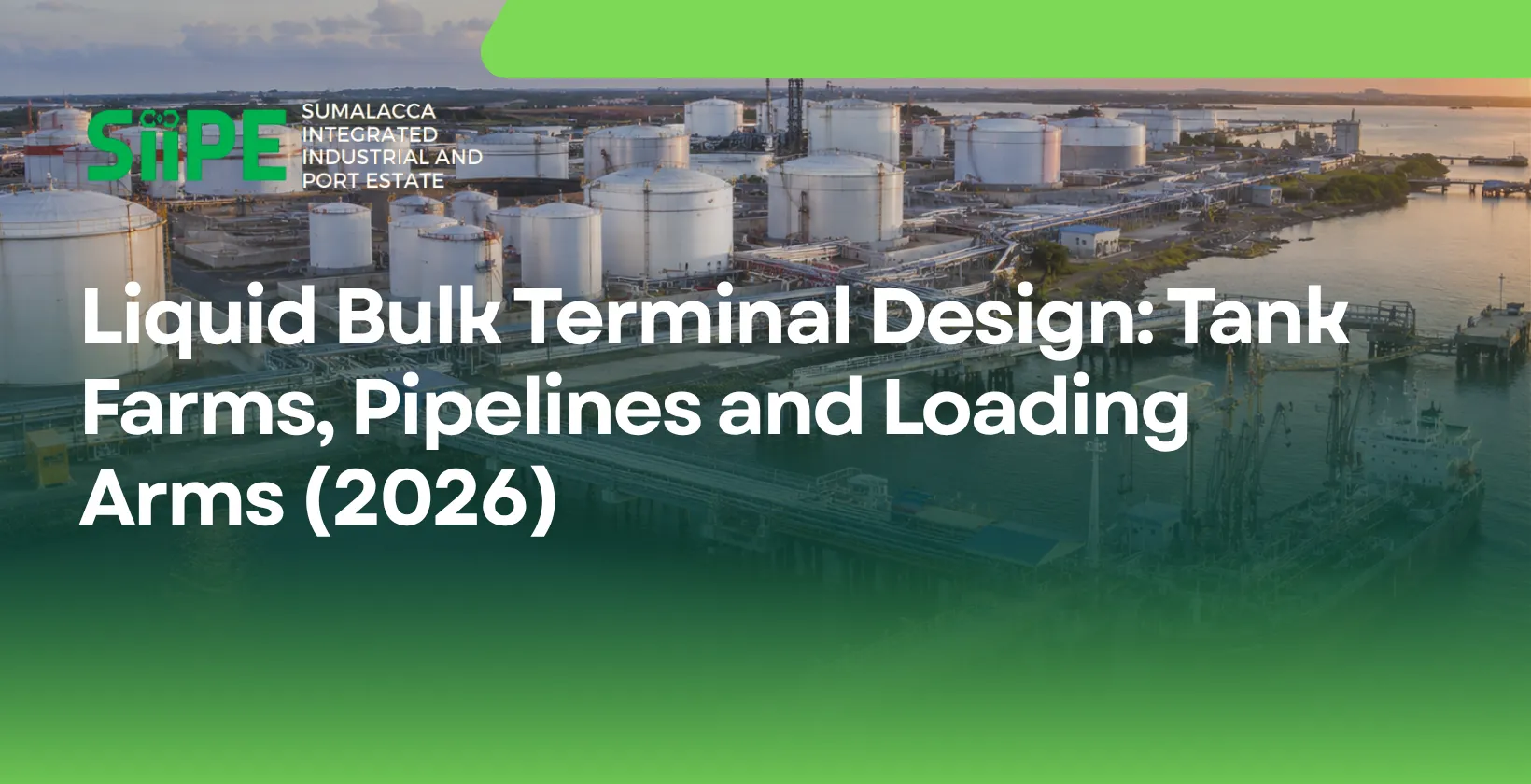
The layout of a liquid bulk terminal is set by two numbers: how many products it must keep apart, and how far the tanks sit from the ship. The berth is usually a jetty: a loading platform on piles, mooring and breasting dolphins to hold the ship, and a trestle carrying the pipelines to shore. A jetty needs no quay wall, so it reaches deep water cheaply, which is why liquid terminals often sit on long trestles. The cost of that reach is paid in pipeline: every product crossing the trestle needs its own line, heated if it is palm oil, and every extra metre is residue to clear between parcels.
The tank farm sits behind the corridor, and its size is driven by product count before volume. Each product or grade that cannot share a tank needs its own, with its own line, pump and manifold connection. A terminal built for one crude palm oil grade is simple; one built for CPO, olein, stearin, two chemicals and a biodiesel feedstock is six small terminals sharing a jetty, and must be designed that way from the start. Our map of Indonesia’s bulk terminals shows how few of the country’s liquid berths are built that way.
Tanks: Standards, Materials and Roofs
Most atmospheric terminal tanks are built to one standard. API 650, Welded Tanks for Oil Storage, now in its thirteenth edition of March 2020, covers vertical, cylindrical, welded steel tanks for liquids at internal pressures up to 17.2 kPa and design temperatures up to 93°C, which is the range a palm oil or chemical tank farm works in.
The standard says what the shell must withstand; the product says what it must be made of. The Codex code of practice for edible oils, carried by FOSFA, prefers stainless steel, accepts mild steel coated internally with an inert material such as phenolic epoxy, and bars copper and its alloys from contact with the oil because they catalyse oxidation. Chemicals impose their own compatibility list, and a tank that has held one cannot return to food-grade service without a documented cleaning regime.
Roofs follow volatility. Palm products and most non-volatile chemicals sit under fixed cone roofs. Volatile petroleum products use floating roofs to limit vapour loss, and oxidation-sensitive chemicals use fixed roofs with a nitrogen blanket, which Codex also recommends for high-quality oils held for long periods.
If you are specifying tankage for a plant in North Sumatra and want to know what the port beside it will be, request the Sumalacca port specifications and our team will send what is published, with the status of each item.
Heating and Insulation for Palm Products
Crude palm oil sets in a cool tank and degrades in a hot one, so a terminal serving palm products is a heating system with tanks attached. The design rules come from the same Codex code, and the temperatures from the PORAM instructions that contracts cite: 32 to 40°C in storage and on the voyage, 50 to 55°C only for loading and discharge.
Codex sets out how to get there without damaging the oil. Hot water at about 80°C circulated through coils is preferred, because it is least likely to overheat the oil at the coil surface. Steam is allowed up to 150 kPa gauge, about 127°C. For melting, a coil area of about 0.1 m² per tonne of tank capacity is recommended, and the heating rate should not exceed 5°C in 24 hours. Temperature is read at top, middle and bottom, at least 30 cm from the coils, and averaged.
The pipelines need the same care. Lines carrying palm products across a trestle are insulated and traced, and the longer the trestle, the more heat is lost and the more residue sets between parcels. Our guide to crude palm oil in Indonesia covers what overheating costs in free fatty acid and bleachability; the design consequence is that heating capacity, not pump capacity, often limits how fast a palm oil terminal can load.
Pipelines, Manifolds and Segregation
Segregation is the discipline that separates a liquid bulk terminal from a tank with a pipe. Dry cargo that gets mixed can be re-sorted; a contaminated liquid parcel is lost.
The design choices run in order of cost. Dedicated lines per product group are the clean answer and the expensive one. Shared lines save pipe but need clearing between products, and Codex requires a common system to be cleared completely between grades, preferably by inert gas or pigging rather than by water, which leaves moisture to hydrolyse the next edible cargo. Manifolds are laid out so that no product can reach another’s line through one mis-set valve, which in practice means double block and bleed between groups, and the system is drawn without dead legs where residue sits and spoils.
Vapour is the other segregation problem. Loading arms for volatile products carry a vapour return line alongside the liquid lines, so displaced vapour goes back to the ship or to a recovery unit rather than to the air. Palm products need none, but a terminal that also serves chemicals or fuels must plan the extra line, the recovery plant and the ignition controls.
Segregation now reaches past the terminal into the supply chain. Certified, deforestation-free palm oil must stay physically apart from conventional oil to keep its claim, as our guide to sustainable palm oil in Indonesia explains. For a tank farm that means more and smaller tanks, dedicated lines and metering at every transfer, specified before the steel is ordered.
Custody Transfer: Meters, Gauges and the Shore Figure
Every parcel that crosses the jetty changes owner, and the bill of lading figure comes from the terminal’s measurement. Its international basis is OIML R 117, the recommendation on dynamic measuring systems for liquids other than water, which national metrology rules follow.
R 117 assigns accuracy classes by application, and the class sets the maximum permissible error for the complete measuring system.
| Application | R 117 accuracy class | Maximum permissible error |
|---|---|---|
| Measuring systems on pipelines | 0.3 | ±0.3% |
| Ship loading; unloading of ships, rail and road tankers | 0.5 | ±0.5% |
| Liquid above 50°C or below -10°C, for classes 0.3 and 0.5 | Class 1.0 limits apply | ±1.0% |
The meters may be positive displacement, turbine, ultrasonic or Coriolis mass meters, each proved against a reference at commissioning and at intervals after.
The last row matters more for palm oil than anything else in the terminal. CPO is loaded at 50 to 55°C, so a palm oil terminal relying on flow meters alone works at the edge of the recommendation’s range, and its tank gauging, with temperature correction, must be good enough to stand on its own. The shore figure from the tanks and the ship figure from the vessel are both recorded, and the difference between them is where loss claims begin.
The specification therefore covers more than the meter: a prover loop or master meter, temperature elements that read the oil rather than the pipe wall, automatic tank gauging on every custody tank, and a measurement procedure both parties sign.
The Jetty: Loading Arms, Rates and Berth Time
The ship connects to shore through hoses or marine loading arms, and the arms are specified against one document. OCIMF’s Design and Construction Specification for Marine Loading Arms, in its fourth edition of 2019, gives owners a set of tables to complete for the vendor: products transferred, the operating envelope the arm must reach, manifold spacing on the ships expected, and the jetty and piping layout it must fit. Completing them is how a terminal makes sure its arms suit the ships that will actually call.
The ships are specified by rule as well as by size. Under MARPOL Annex II, vegetable oils including palm oil are pollution category Y, and under the IBC Code most call for a ship type 2, with an approved exemption for type 3 ships whose cargo tanks are arranged as type 2, according to ClassNK’s technical summary. Solidifying and high-viscosity category Y cargoes must be prewashed with water of at least 60°C, so the ships need cleaning-water heating. A tanker carrying palm products is a chemical tanker in regulatory terms, and the berth is designed for one.
Berth time is arithmetic, and the terminal controls most of the inputs. A 10,000-tonne parcel pumped at 300 tonnes an hour takes about 33 hours of pumping; at 600 tonnes an hour, 17. Connection, sampling, line clearing and paperwork add hours at either end. The rate is set by the slowest element in the chain, which is rarely the ship: a Pelindo terminal at Pangkal Balam raised its CPO transfer rate from 40 to 200 tonnes an hour in 2024 by moving from direct truck discharge through a 4-inch hose to a drop tank with submersible pumps and a 6-inch line. At a jetty the same logic applies: arm size, pump head, heating capacity and metering throughput are specified together, because the smallest of them sets the laytime.
Containment and Fire Protection
Every tank sits inside a bund, and the sizing rule is simple: under NFPA 30, the diked area must hold at least the volume of the largest tank within it, with drain valves kept closed during operation so a spill cannot reach the sea. Edible oils are not flammable the way fuels are, but a palm oil spill into an estuary is an environmental incident, and the bund, drainage interceptors and oil-water separator are designed for it.
Chemical and fuel tankage brings the full flammable liquids regime: tank spacing by class, foam and cooling water, flame arrestors on vents, earthing and bonding at the jetty, and the ISGOTT ship-shore safety checklist for every transfer. A terminal serving both palm products and chemicals is designed to the stricter regime from the start, because retrofitting fire protection is slower and dearer than building it in.
What SIIPE Is Planning
We are applying the checklist above to our own plan, which is at the stage where the answers are still being written.
SIIPE (Sumalacca Integrated Industrial and Port Estate) is a planned 5,600-hectare integrated industrial estate, deep seaport and township in Medan Belawan, North Sumatra, 4.7 km from Belawan Port. Around 840 hectares is acquired and the remaining 4,760 hectares still has to be acquired or reclaimed. The current development phase covers 3,000 hectares: 1,800 ha industrial estate, 400 ha deep seaport and 800 ha residential township.
The Sumalacca Dry & Liquid Bulk Port is planned, not operational, and is a medium-term objective on our roadmap. Its published design is a basin of -8 to -10 m LWS with a 13 nautical mile approach channel to the Strait of Malacca, which suits Handysize and smaller Supramax tankers. A chemical storage tank facility and a jetty are on the estate’s planned infrastructure list, and the plan states no capacities or operational status for them, so we quote no tank volume, arm size, loading rate or berth count.
What the plan does fix is the layout decision this guide began with: plantation processing, chemical and dry bulk plots designed to sit under 5 km from the estate’s own berth, so the corridor between tank and ship is short and inside one fence. Tank materials, heating, segregation and metering are the items a prospective tenant can still shape, which is the reason to talk to us before the drawings are frozen.
Frequently Asked Questions
What is a liquid bulk terminal?
A liquid bulk terminal is a port facility that transfers unpackaged liquids such as palm oil, chemicals and fuels between ships and shore through a closed system of loading arms or hoses, pipelines, pumps and storage tanks. Its design is governed by product segregation, temperature control, custody measurement and spill containment.
What standard are liquid bulk terminal storage tanks built to?
Most atmospheric terminal tanks are built to API 650, the standard for welded steel tanks at internal pressures up to 17.2 kPa and design temperatures up to 93°C. For edible oils, the Codex code of practice adds material rules: stainless steel preferred, coated mild steel acceptable, and no copper alloys in contact with the oil.
How are palm oil storage tanks heated?
Codex practice recommends hot water at about 80°C circulated through coils, with steam permitted up to 150 kPa gauge. A coil area of about 0.1 m² per tonne is suggested for melting, and heating should not exceed 5°C in 24 hours. Crude palm oil is held at 32 to 40°C and raised to 50 to 55°C only for loading.
How accurate must custody transfer metering be?
OIML R 117 sets accuracy class 0.3 for measuring systems on pipelines and class 0.5 for ship loading and unloading, with maximum permissible errors of ±0.3% and ±0.5% for the complete system. Where the liquid is above 50°C, as crude palm oil is at loading, the wider class 1.0 limits apply instead.
What ship rules apply to palm oil cargoes?
Under MARPOL Annex II, vegetable oils including palm oil are pollution category Y and are carried on chemical tankers meeting the IBC Code, generally ship type 2 or an approved type 3 arrangement. Solidifying or high-viscosity cargoes must be prewashed with water of at least 60°C, so vessels need cleaning-water heating.
Request Sumalacca Port Specifications
If you are sizing tanks, lines and a berth for a plant in Sumatra, design against the terminal your plant will actually use. SIIPE is a planned 5,600-hectare estate in Medan Belawan with a current 3,000-hectare development phase, around 840 hectares acquired, and a site 4.7 km from Belawan Port. The Sumalacca Dry & Liquid Bulk Port is planned rather than operational, and we will say so in every document we send.
Ask our team for the published port design, the status of the port and reclamation licences, and the plots nearest the planned berth. Request port specifications through the contact page, selecting Port Area as your interest, or message us on WhatsApp at +62 811 860 980.