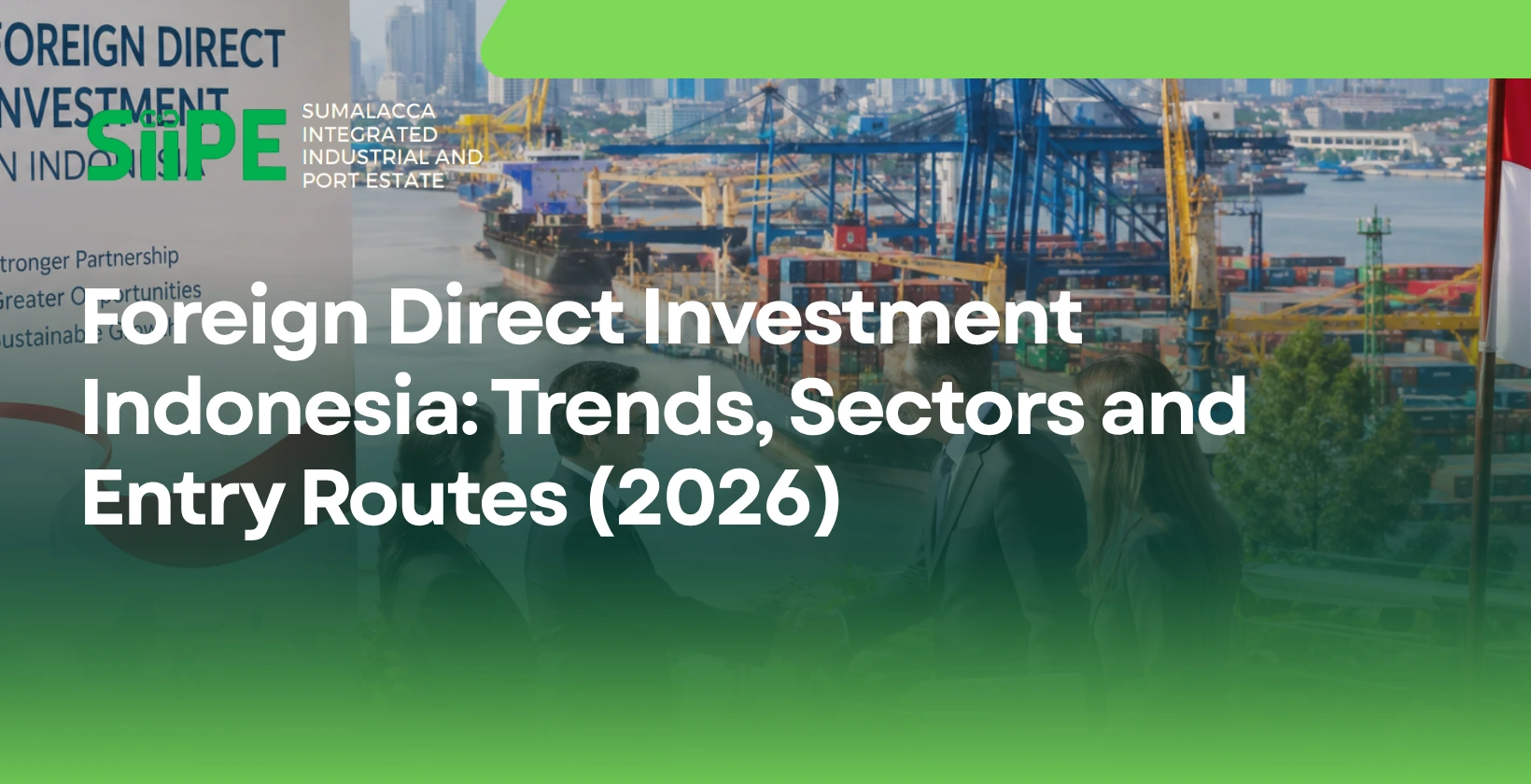
Foreign direct investment Indonesia reached Rp507.6 trillion in the first half of 2026, 50.2% of the Rp1,010.6 trillion in total realised investment that the Ministry of Investment and Downstreaming (BKPM) reported for the period. That is the headline. The useful part for anyone choosing a site is underneath it: which sectors the money went to, which countries it came from, which provinces received it, and how a foreign company actually gets in.
This page is our investor-relations reference. It pulls the official realisation data together in English, adds a North Sumatra cut that is rarely published, and sets out the entry routes and incentives as the current regulations define them. We refresh it each quarter when BKPM releases new figures.
One note on definitions. BKPM’s “PMA” figure counts realised capital expenditure by foreign-invested companies, reported through OSS. It is not the balance-of-payments FDI that Bank Indonesia and UNCTAD publish, so the two will never match exactly. They answer different questions.
Last updated: 24 September 2026
Foreign Direct Investment Indonesia: Headline Numbers, 2024 to Mid-2026
Indonesia’s realised investment has grown every year for the past five years, and the foreign share of it has moved around more than the total suggests. The table below uses BKPM’s annual and semester releases.
| Period | Total realisation | Foreign (PMA) | Domestic (PMDN) | Growth (total, YoY) | Direct jobs |
|---|---|---|---|---|---|
| 2024 | Rp1,714.2 trillion | Rp900.2 trillion (52.5%) | Rp814.0 trillion (47.5%) | +20.8% | 2,456,130 |
| 2025 | Rp1,931.2 trillion | Rp900.9 trillion (46.6%) | Rp1,030.3 trillion (53.4%) | +12.7% | 2.71 million |
| Semester I 2026 | Rp1,010.6 trillion | Rp507.6 trillion (50.2%) | Rp502.9 trillion (49.8%) | +7.2% | 1,448,862 |
Three things stand out. First, foreign direct investment in Indonesia was essentially flat in rupiah terms between 2024 and 2025, at Rp900.2 trillion then Rp900.9 trillion, while domestic investment jumped 26.6%. The 2025 record was a domestic story. Second, the foreign share recovered to just over half in the first six months of 2026, so the balance is shifting back. Third, growth is slowing: 20.8% in 2024, 12.7% in 2025, 7.2% in the first half of 2026. The Semester I 2026 release puts the half-year at 49.5% of the 2026 national target of Rp2,041.3 trillion, which is on track but with less headroom than the last two years enjoyed.
The global backdrop helps explain the slowdown. UNCTAD’s World Investment Report 2026 puts global FDI at $1.6 trillion in 2025, up 6% after two years of decline, with South-East Asia receiving $244 billion, up from $222 billion, and eight of the region’s eleven economies growing. Indonesia is singled out for continuing to attract investment in mineral processing, battery-related value chains and digital infrastructure. Those three themes run through every table that follows.
Where the Money Goes: Sectors
Sector data is where the realisation figures become useful for a manufacturer, because it shows what kind of capacity is being built and where the crowding is. The first half of 2026 broke down like this (PMA and PMDN combined).
| Sector (Semester I 2026) | Realisation | Share |
|---|---|---|
| Basic metals and metal goods | Rp150.4 trillion | 14.9% |
| Other services (including data centres) | Rp114.0 trillion | 11.3% |
| Mining | Rp105.0 trillion | 10.4% |
| Transport, warehousing and telecommunications | about Rp103 trillion | 10.2% |
| Housing, industrial estates and offices | Rp85.5 trillion | 8.5% |
Basic metals has led the table for several years, and it is the sector most closely tied to the downstreaming policy: nickel, copper and bauxite processing that follows the raw-ore export restrictions. Downstreaming (hilirisasi) investment as a whole reached Rp299.7 trillion in the half, 29.7% of the total, with Rp206.5 trillion of that in minerals and 75.7% of it located outside Java. For the full year 2025 the same category was Rp584.1 trillion, up 43.3%, a large part of why the outside-Java share reached 51.3% for the year.
The second-place entry is the newer story. BKPM attributes the “other services” line largely to data centres, and together with the transport, warehousing and telecommunications line it means as much as a fifth of realised investment is now infrastructure for the digital economy and logistics rather than for making goods.
For a manufacturer the reading is simple. Metals, mining and data centres absorb capital, land and power in the provinces where their resources sit. Process manufacturing that does not depend on an ore body, whether palm oil derivatives, chemicals, food, or building materials, is competing for a smaller slice of the attention and still needs serviced land near a port. That is an opening.
If you are weighing a plant in Sumatra against Java, our investment team can walk you through current land availability and indicative terms. Book an investor call and we will come with the province-level numbers.
Who Is Investing: Source Countries
The country ranking says as much about how capital is structured as about where it originates, because a large share of Asian and Western investment reaches Indonesia through Singapore holding companies. With that caveat, the first half of 2026 ranked as follows.
| Source country (Semester I 2026) | PMA realisation |
|---|---|
| Singapore | $8.8 billion |
| Hong Kong | $7.8 billion |
| China | $3.9 billion |
| Japan | $1.9 billion |
| United States | $1.7 billion |
Hong Kong topped the second quarter on its own at $5.0 billion, ahead of Singapore’s $4.2 billion, with China, Japan and Malaysia completing the quarter’s top five. Much of the Hong Kong and China flow tracks the metals processing projects in Sulawesi and North Maluku, which is why those two provinces appear high in the PMA ranking despite modest domestic investment.
For the whole of 2025 Singapore led again at $17.4 billion, followed by Hong Kong, China, Malaysia and Japan. The pattern has been stable for a decade: Singapore first, a Greater China entry second or third, Japan and Malaysia in the middle, and the United States or South Korea appearing depending on the year’s large projects.
Two practical consequences. If your group already holds its ASEAN investments through Singapore, you will be entering the way most capital does, and BKPM is used to the structure. If you are a Japanese, Korean or European manufacturer investing directly, you are a smaller part of the flow, and provincial investment offices trying to diversify their source-country mix will notice. North Sumatra is a case in point.
Where It Lands: Provinces and the North Sumatra Cut
Provincial data decides more site-selection arguments than national data, and the balance has tilted outside Java. In the first half of 2026 Java received Rp502.8 trillion (49.8%) and the rest of the country Rp507.8 trillion (50.2%).
| Province (Semester I 2026) | Realisation | Rank |
|---|---|---|
| DKI Jakarta | Rp173.6 trillion | 1 |
| West Java | Rp138.1 trillion | 2 |
| East Java | Rp72.7 trillion | 3 |
| Central Sulawesi | Rp68.7 trillion | 4 |
| Banten | Rp66.3 trillion | 5 |
| North Maluku | Rp65.4 trillion | 6 |
| Central Java | Rp48.5 trillion | 7 |
| Riau Islands | Rp40.4 trillion | 8 |
| East Kalimantan | Rp34.1 trillion | 9 |
| Riau | Rp33.1 trillion | 10 |
Central Sulawesi and North Maluku are the metals story again: North Maluku alone drew Rp39.5 trillion of foreign investment in the second quarter, the most of any province. Within Sumatra, the second-quarter figures reported by provincial investment offices put Riau first at Rp20.23 trillion, then Riau Islands at Rp16.60 trillion, South Sumatra at Rp14 trillion, North Sumatra at about Rp9.5 trillion and Lampung at Rp7.4 trillion.
North Sumatra in numbers
North Sumatra is Sumatra’s most populous province, and its investment numbers are climbing faster than the national average. According to the provincial government’s investment review, realisation rose from Rp39 trillion in 2023 to Rp48.2 trillion in 2024 and Rp58.5 trillion in 2025, beating the Rp53.67 trillion target BKPM had set for the province. The governor’s stated target is Rp100 trillion a year by 2029.
The composition matters more than the total for a foreign investor:
- Through the third quarter of 2025 the province had realised Rp42.36 trillion across 21,041 projects, of which foreign investment was Rp20.06 trillion in 1,686 projects and domestic investment Rp22.3 trillion in 19,355 projects. Foreign projects are few and large; domestic ones are many and small.
- Foreign investment was led by the chemical and pharmaceutical industry, with transport, warehousing and telecommunications, food processing, and electricity, gas and water behind it. Domestic investment was led by food.
- Singapore supplied about 61% of the province’s foreign investment, followed by the Netherlands, Malaysia, the United Kingdom and China.
- The leading locations were Simalungun, home to the Sei Mangkei special economic zone, then Medan, Deli Serdang, South Tapanuli and Langkat.
At Rp58.5 trillion, North Sumatra accounted for roughly 3% of national realisation in 2025. That is small enough that a single large plant moves the provincial ranking, which is why a serious enquiry gets direct attention from the provincial investment office.
What Is Driving the Trend
Four policy levers explain most of the movement in foreign direct investment in Indonesia over the past five years, and each one shapes how a foreign manufacturer should plan its entry.
Downstreaming. Export restrictions on raw minerals, starting with nickel ore, forced processing capacity to be built onshore. That policy is the reason basic metals leads every sector table and the reason capital has flowed to Sulawesi and the Malukus. The government has said it intends to extend the approach to other commodities, including agricultural ones, which is where Sumatra’s palm oil and rubber base becomes relevant.
The Positive Investment List. Presidential Regulation No. 10 of 2021 on investment business fields, as amended by Presidential Regulation No. 49 of 2021, replaced the old negative list. It sets out priority business fields eligible for fiscal and non-fiscal incentives, fields reserved for or requiring partnership with cooperatives and small enterprises, fields open with conditions, and everything else, which is open to 100% foreign ownership. Most industrial manufacturing sits in the open or priority categories.
Risk-based licensing. Business licensing runs through the OSS system on a risk basis: a business identification number (NIB) alone for low-risk activities, an NIB plus a standards certificate for medium risk, and a full licence for high risk. The governing instrument changed in June 2025, when Government Regulation No. 28 of 2025 replaced Government Regulation No. 5 of 2021 and introduced service-level commitments for permit processing. Any guide that still quotes the 2021 regulation is out of date.
Special economic zones and the industrial estate rule. Indonesia’s Industry Law requires industrial companies to locate inside an industrial estate, with limited exceptions, and its special economic zones offer the deepest fiscal facilities. Our guide to special economic zone incentives in Indonesia explains what each designation actually gives a tenant and how to tell a granted status from an application.
Entry Routes for Foreign Capital
A foreign investor has a small number of legal routes into Indonesia, and the choice is usually settled by the business field and the timeline rather than by preference. The rules below are current as of the Ministry of Investment and Downstreaming/BKPM regulation of 2025.
| Route | What it is | When it fits |
|---|---|---|
| New PT PMA | A foreign-invested limited liability company established under Indonesian law | Greenfield plants, full control, most manufacturing |
| Acquisition of an existing PT | Buying shares in a local company, which then converts to PMA status | Speed, existing licences and land, brownfield capacity |
| Joint venture PT PMA | A PMA with an Indonesian partner holding a defined stake | Fields where the Positive Investment List requires partnership, or where a local partner brings land or distribution |
| Representative office | A liaison presence that cannot trade or invest | Market study before committing capital |
The PT PMA in practice. The company is formed by deed, registered with the Ministry of Law, and obtains its NIB through OSS, which is also where the investment plan is recorded. Under Article 26 of the Ministry of Investment and Downstreaming/BKPM Regulation No. 5 of 2025, the total investment must exceed Rp10 billion, excluding land and buildings, for each five-digit KBLI business field at each project location.
The same article sets minimum issued and paid-up capital at Rp2.5 billion per company, reduced from the Rp10 billion that the 2021 regulation required, with a self-declaration that the capital stays in the company for twelve months. Our step-by-step guide to how to invest in Indonesia as a foreigner takes the PT PMA from deed to NIB in that order.
That reduction is the most significant change to entry rules in several years. It does not lower the size of the project you must commit to, but it does lower the cash you must park in the company on day one.
Sequencing. Formation and NIB typically take weeks. The long items are land, environmental approval and the sector operating permit, and they run in parallel with construction planning. Our guide to doing business in Indonesia covers the corporate and tax set-up in order, and the land question, including why a foreign company holds its plot under HGB rather than freehold, is answered in our article on whether foreigners can invest in Indonesia.
Incentives and the Tax Holiday Question
Indonesia’s incentives are granted by the central government against conditions, never by an estate developer, and the largest of them is in transition. Read this section as a map of what to ask for, not a promise of what you will get.
Tax holiday. Under Ministry of Finance Regulation No. 130 of 2020 as amended by Regulation No. 69 of 2024, pioneer industries investing Rp100 billion to under Rp500 billion could obtain a 50% corporate income tax reduction for five years, and those investing Rp500 billion or more a 100% reduction for five to twenty years, scaled by investment size. Eighteen pioneer industry groups qualify, including basic metals, chemicals, pharmaceuticals and electronics. The 2024 amendment extended the registration window to 31 December 2025 and added a global minimum tax clause.
That clause is the transition. Indonesia implemented the OECD 15% global minimum tax from the start of 2025 for multinational groups with consolidated revenue of EUR 750 million or more. For a group of that size, a holiday that pushes the Indonesian effective rate below 15% triggers a top-up tax somewhere in the group, so the facility no longer eliminates the liability. The government has said the tax holiday continues into 2026 on that basis and has discussed a refundable tax credit design as the longer-term replacement. Check the instrument in force on the day you apply.
Other facilities. The tax allowance (investment allowance, accelerated depreciation, reduced dividend withholding) covers a wider list of fields at lower thresholds. Import duty exemption on capital goods and, for two years, on raw materials is available to new industrial companies through the BKPM master list. Special economic zones layer their own facilities on top, and bonded zones defer duty and VAT for export processors.
Risks Investors Price In
Every investment climate survey of Indonesia lists the same risks, and the practical question is how to structure around them rather than whether they exist.
- Regulatory change. Three of the instruments that govern a plant’s life have been replaced since 2024: the industrial zoning regulation, the risk-based licensing regulation and the BKPM implementing regulation. Each change was an improvement, but each also stranded published guides. Build a regulatory review into your annual compliance calendar.
- Local content and partnership pressure. Some sectors carry local content, divestment or partnership expectations that are not always written into the Positive Investment List. Confirm them for your specific KBLI before the term sheet.
- Contract enforcement and title. Dispute resolution is slow, and land title is the item most often found to be weaker than described. Fourteen questions that surface these issues early are in our due diligence checklist for an industrial estate in Indonesia.
- Currency and repatriation. The rupiah is convertible and profits are repatriable, but the currency moves, and a plant that imports equipment and sells domestically carries the mismatch. Plan in dollars, report in both.
None of these has stopped $8.8 billion of Singapore-routed capital or $7.8 billion of Hong Kong capital arriving in six months. They are costs to price, not reasons to stay out.
What the Data Means for Site Selection at SIIPE
We develop an estate in North Sumatra, so we read these tables with one question in mind: where does a foreign process manufacturer that does not need an ore body fit? Our answer is on the coast, near an operating port, in a province growing faster than the national average and courting a broader mix of investors.
SIIPE (Sumalacca Integrated Industrial and Port Estate) is a planned 5,600-hectare integrated industrial estate, deep seaport and township in Medan Belawan, North Sumatra. Around 840 hectares is acquired and the remaining 4,760 hectares still has to be acquired or reclaimed. The current development phase covers 3,000 hectares: 1,800 ha industrial estate, 400 ha deep seaport and 800 ha residential township. The site sits 4.7 km from Belawan Port, about 10 minutes by road, and 38.8 km from Kuala Namu International Airport.
The estate is planned around the sectors that already lead North Sumatra’s foreign investment: crude palm oil and plantation processing, chemical and pharmaceutical, cement and dry bulk, commodities and manufacturing, and logistics and warehousing. The Sumalacca Dry & Liquid Bulk Port is planned, not operational, and estate utilities are planned, so we quote no connected capacity today. SIIPE does not hold special economic zone or free trade zone status; the licence is in process. A full profile, with the status of every component, is on our Sumalacca Integrated Industrial and Port Estate page.
Set against the data, the case is this: an operating port 4.7 km away in a province where foreign investment is led by chemicals and pharmaceuticals, in a country where the outside-Java share of investment has just crossed 50%. The trade you are assessing is early-phase status against that position.
Frequently Asked Questions
How much foreign direct investment did Indonesia receive in 2025?
BKPM recorded foreign investment (PMA) realisation of Rp900.9 trillion in 2025, 46.6% of total realised investment of Rp1,931.2 trillion. In the first half of 2026 foreign investment reached Rp507.6 trillion, 50.2% of the Rp1,010.6 trillion total, with Singapore, Hong Kong and China the leading sources.
Which sectors attract the most foreign investment in Indonesia?
Basic metals and metal goods led in the first half of 2026 with Rp150.4 trillion, followed by other services including data centres, mining, transport and telecommunications, and real estate and industrial estates. Downstream mineral processing, digital infrastructure and battery value chains are the themes UNCTAD highlights for Indonesia.
Which countries invest the most in Indonesia?
Singapore has led for more than a decade, with $8.8 billion in the first half of 2026 and $17.4 billion in 2025. Hong Kong, China, Japan and the United States completed the 2026 half-year top five. Much of the Singapore figure is capital from elsewhere routed through Singapore holding companies.
What is the minimum investment for a foreign company in Indonesia?
Under BKPM Regulation No. 5 of 2025, a PT PMA must plan total investment above Rp10 billion, excluding land and buildings, per five-digit KBLI business field per project location. Minimum issued and paid-up capital is Rp2.5 billion per company, reduced from the Rp10 billion required under the 2021 rules.
Can a foreign company own 100% of a business in Indonesia?
In most business fields, yes. Presidential Regulation No. 10 of 2021, as amended by Regulation No. 49 of 2021, opens fields to full foreign ownership unless they are reserved for cooperatives and small enterprises or listed with conditions such as a foreign ownership cap or a partnership requirement. Most manufacturing is open.
How much foreign investment goes to North Sumatra?
North Sumatra realised Rp58.5 trillion in total investment in 2025, up from Rp48.2 trillion in 2024. Through the third quarter of 2025 foreign investment accounted for Rp20.06 trillion across 1,686 projects, led by the chemical and pharmaceutical industry, with Singapore supplying about 61% of the foreign total.
Talk to SIIPE’s Investment Team
If the numbers above have moved Sumatra onto your shortlist, the next step is a conversation about a specific plot. SIIPE is a planned 5,600-hectare estate in Medan Belawan with a current 3,000-hectare development phase, around 840 hectares acquired, and a site 4.7 km from Belawan Port. Its port and utilities are planned rather than operational, and we will say so in every meeting.
Our investment team will bring current land availability, indicative terms and the province-level investment data for your sector. Book an investor call through the enquiry form, or message us on WhatsApp at +62 811 860 980 and we will come back with dates.