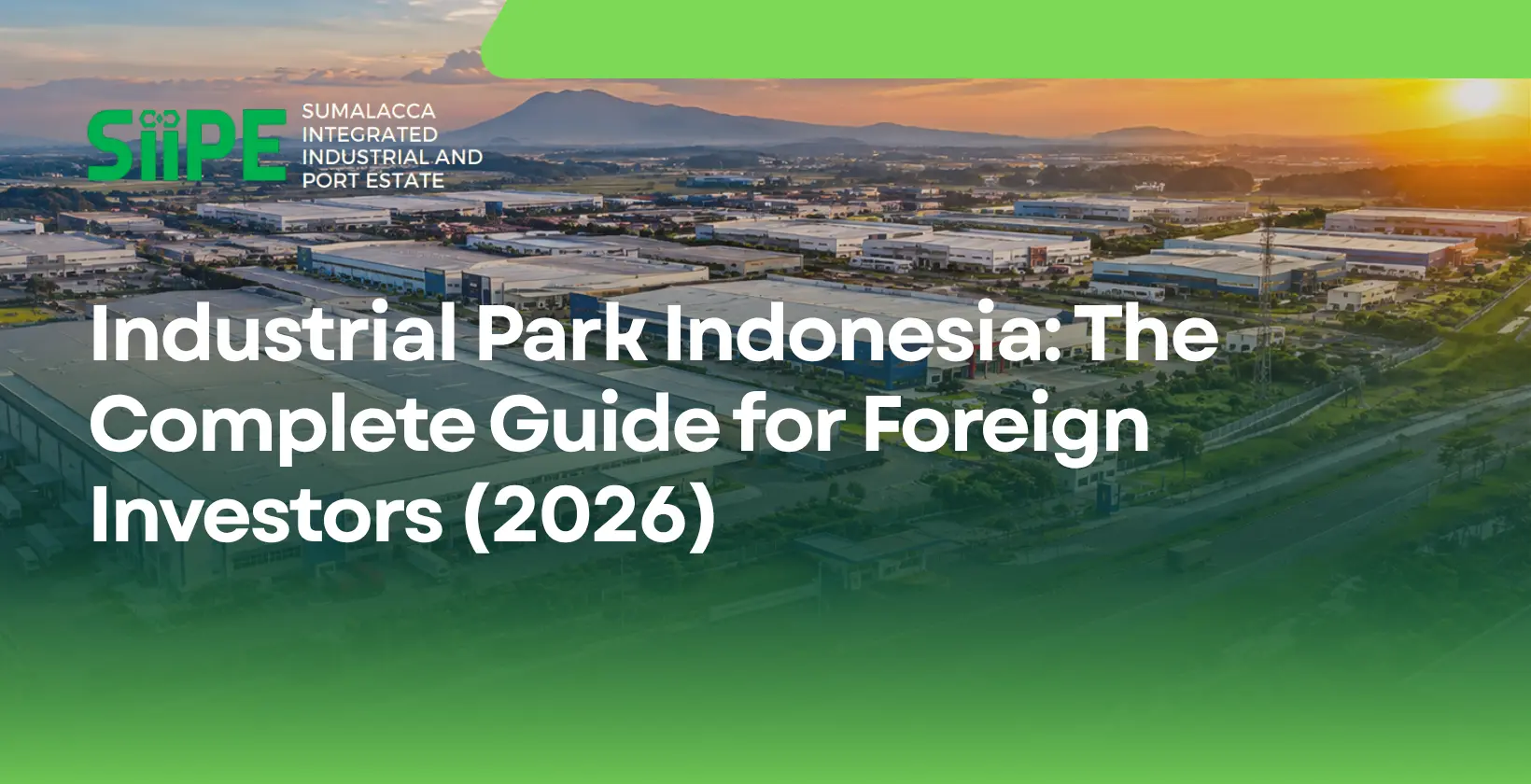
Industrial park Indonesia decides more of your cost base than most site-selection shortlists admit. The park sets your utility supply, your permit route, your neighbours, your distance to a berth, and in many regencies it decides whether you are allowed to build at all.
This guide covers what an Indonesian industrial park legally is, how the zone types differ, what the sector looks like in 2026, how land tenure and licensing work for a foreign-invested company, what drives cost, and what to verify before you sign. We develop an estate ourselves, so this is written from the developer’s side of the table.
Last updated: 18 September 2026
What an Industrial Park in Indonesia Actually Is
An industrial park in Indonesia, called a kawasan industri locally, is a licensed area developed and managed by an estate company for industrial tenants. The estate company holds the land, builds the roads and utilities, obtains the area-level permits, and sells or leases serviced plots. You buy a plot with services attached, not raw land.
The legal frame changed recently, and it is the point most English-language guides still get wrong. Government Regulation No. 142 of 2015 on industrial estates has been revoked. Industrial zoning now sits under Government Regulation No. 20 of 2024 on industrial zoning, enacted on 7 May 2024, which covers industrial development zones, industrial designation areas and small-industry clusters, and requires spatial planning, resource use and environmental impact to be weighed together.
The obligation to sit inside an estate comes from the Industry Law. Article 106 of Law No. 3 of 2014 requires an industrial company to locate in an industrial estate. Two exceptions apply: regencies or cities that have no industrial estate, and regencies or cities where every plot in the estate is taken. Small and micro industry is treated separately. For a foreign manufacturer, the practical reading is simple. Outside the exceptions, the estate is not an option among many, it is the compliant location. Your choice is which estate, not whether.
Indonesia’s Industrial Estate Sector in 2026
Indonesia’s estate sector is large, and it is not evenly used. The Ministry of Industry counted 180 industrial estates covering more than 101,000 hectares in figures presented in July 2026.
A month earlier the same directorate reported occupancy across those estates at 57.20 percent, with 11,970 companies operating inside them, 2.35 million workers employed, and cumulative investment of Rp6,744.58 trillion, according to Ministry of Industry data reported in June 2026.
Read that occupancy figure carefully. At 57.20 percent nationally, there is serviced land available, but availability clusters in the estates furthest from the markets and ports that most investors want. Scarcity is local, not national. The investment backdrop is solid. Indonesia recorded Rp1,010.6 trillion of investment realisation in the first half of 2026, up 7.2 percent year on year and employing 1,448,862 people directly, according to the Ministry of Investment. That was 49.5 percent of the year’s Rp2,041.3 trillion target at the half-year mark.
Zone Types: KI, KEK, Bonded Zone and FTZ
Four labels get used interchangeably in English-language material, and they are not the same thing. The table separates them.
| Zone type | What it is | What it gives a tenant |
|---|---|---|
| Kawasan Industri (KI) | Standard licensed industrial estate | Serviced land, estate infrastructure, area-level permits, compliance with Article 106 |
| KEK (Kawasan Ekonomi Khusus) | Special economic zone designated by government regulation | Fiscal and customs facilities on top of estate services, subject to qualifying conditions |
| Kawasan Berikat (bonded zone) | Customs facility over a specific plant or area | Deferred or relieved import duty and tax for export-oriented production |
| FTZ (free trade zone) | Designated free trade and free port area, such as Batam | Customs treatment at the area level |
The fiscal difference is real but smaller than the brochures suggest. Special economic zones across Indonesia drew Rp32 trillion in the first half of 2026, of which Rp24 trillion was foreign, reported by DDTC News from National KEK Council figures. That is 3.16 percent of national investment realisation in the same period. Most manufacturing investment in Indonesia lands in ordinary industrial estates, not in special economic zones.
Our explainer on Indonesia’s industrial zone types sets out the differences in detail, and our guide to special economic zone incentives covers what qualifying for KEK status actually requires.
Why Locate Inside an Estate at All
Compliance with Article 106 is the legal reason. The operational reasons are what you will feel monthly.
- Utilities are already sized and connected. Power, water, wastewater treatment and gas reach the plot boundary, so you are not negotiating a private connection with each utility.
- Area-level permits are already carried. The estate holds the environmental and spatial approvals for the area, which shortens what you have to obtain yourself.
- Spatial zoning is settled. The land is already designated for industry in the regional spatial plan, which is the single most common reason a standalone site fails due diligence.
- Neighbours are industrial. Residential encroachment is the slow risk that turns a viable plant into a community dispute ten years later.
- The estate manager is accountable. Roads, drainage, security and fire response sit with a company you can hold to a service standard, funded by the estate service charge.
The trade is the service charge and less freedom over the site. For most manufacturers the arithmetic favours the estate, but ask for the service charge schedule before you assume it.
Building in North Sumatra? Download the SIIPE e-brochure (PDF) for the masterplan of a planned estate 4.7 km from Belawan Port.
What “Serviced Land” Includes, and What It Does Not
“Ready to build” is the most stretched phrase in Indonesian industrial property, so define it against the plot you are being offered. In a well-developed estate, a serviced plot means the land is cut and levelled to a stated finished level, a paved estate road reaches the boundary, power, water, gas and telecoms are stubbed to the boundary at a stated capacity, the estate’s drainage takes your surface water, and a wastewater connection accepts your effluent within defined limits.
Four things are usually not included, and each one is a line in your capital budget:
- Site preparation inside your boundary, including piling if the soil demands it
- The transformer, substation and internal reticulation on your side of the meter
- Effluent pre-treatment to bring your discharge within the estate’s acceptance limits
- Your own permits, from building approval to sector operating licences
Ask for the estate’s effluent acceptance limits and the guaranteed power capacity per hectare in writing. Both are ordinary requests, and an estate that hesitates over either is worth a second look.
Where the Estates Are: Java and Everywhere Else
The geography of Indonesian industrial estates is lopsided, and it is shifting. Of the 180 estates the Ministry of Industry counted in July 2026, 107 are on Java, covering roughly 39,000 hectares, while 73 sit outside Java across roughly 62,000 hectares.
| Region | Estates | Approximate area |
|---|---|---|
| Java | 107 | ~39,000 ha |
| Outside Java | 73 | ~62,000 ha |
Java has more estates on less land: dense, mature, close to the largest consumer market, and priced accordingly. Outside Java the estates are fewer and far larger, usually built around a resource base or a port, with more room to expand and a shorter queue for utilities.
Neither is better in the abstract. If your output serves Indonesian consumers, Java’s market density is hard to beat. If you process a commodity, export most of your volume, or need a large contiguous site, the arithmetic moves outward, and the Ministry of Industry has been explicit that it wants estates to work as instruments of distributing industry beyond Java.
The honest caveat for any site outside Java: verify the infrastructure that is actually built rather than the infrastructure that is masterplanned. That applies to our own estate as much as anyone else’s, which is why the section on SIIPE below states what is planned and what is not.
Which Industries Suit Which Region
Location logic in Indonesia follows cargo, not prestige. A few patterns hold consistently.
- Consumer goods, food and beverage, pharmaceuticals and automotive components favour Java, where the consumer market, the supplier base and the skilled labour pool are deepest.
- Commodity processing, from crude palm oil to rubber, cocoa and fisheries, favours proximity to the raw material and to an export berth, which usually means Sumatra, Kalimantan or Sulawesi.
- Mineral processing and smelting follows the ore body, which is why the largest estates outside Java are built around specific deposits.
- Chemicals and dry bulk favour bulk-capable port access, because the freight cost of moving bulk overland erases a land-price saving quickly.
- Warehousing and distribution follows the consumer market for domestic goods, and the port for transit cargo.
The mismatch to avoid is an export-oriented processor placed inland from a congested container port. The land price looks attractive, then every tonne pays for the distance twice, once in trucking and once in the working capital tied up in transit time.
Land Tenure and Foreign Ownership
A foreign-invested company in Indonesia operates as a PT PMA, and a PT PMA cannot hold hak milik, the freehold ownership title, because Article 21 of the Basic Agrarian Law reserves it for Indonesian citizens and designated bodies. You will not own Indonesian land outright, and no estate can change that.
What you can hold is HGB (Hak Guna Bangunan), the right to build, granted for a fixed term with extension and renewal available. In practice an estate either transfers an HGB certificate over your plot or grants HGB over its own management right. Both are normal. What matters is which one you are getting, what term it carries, and what happens at renewal.
Two questions decide whether a plot is clean. First, what document sits under it today: a registered certificate, or a local land letter that still has to be converted. Second, whether the parcel is inside the area covered by the estate’s own licence. Our guide to land ownership rules for foreign companies walks through the mechanism.
Sector eligibility is separate from land. Indonesia’s Positive Investment List, set by Presidential Regulation No. 10 of 2021 as amended by Presidential Regulation No. 49 of 2021, determines which business fields allow 100 percent foreign ownership and which carry conditions. An estate saying “100% foreign ownership welcome” is describing its own position, not granting you an entitlement. Check your KBLI code before you design the shareholding.
Licensing: PT PMA, OSS-RBA and the Estate’s One-Stop Service
Company and permit sequencing is where schedules slip. The route runs in this order.
- Establish the PT PMA and obtain a business identification number (NIB) through the risk-based online single submission system, OSS-RBA.
- Secure the plot and the land documents described above.
- Obtain the building and environmental approvals your risk class requires, which the estate’s area-level approvals reduce but do not remove.
- Connect utilities under the estate’s tie-in procedure.
- Complete operational permits for your specific process, which vary by sector.
Most established estates run a one-stop service to handle the estate-level steps with you. The service is real and it saves weeks, but read what it covers. It usually covers estate permits, utility connections and tenant onboarding, not your corporate licensing or your sector-specific approvals.
Our article on doing business in Indonesia covers the company-level requirements, including current capital thresholds.
What Drives Cost in an Indonesian Industrial Park
Land price is the number investors compare, and it is rarely the number that decides the case. Five components move the total.
| Cost component | What to ask the estate |
|---|---|
| Land price | Price per square metre, payment terms, and what “serviced” includes |
| Estate service charge | Monthly or annual rate, what it funds, how it escalates |
| Utility connection and tariff | Connection cost, guaranteed capacity, tariff structure, backup arrangements |
| Construction | Soil conditions, piling requirements, site levels and flood history |
| Landed logistics cost | Distance to the berth your cargo actually uses, and the road it travels |
Labour sits alongside these and is set locally, not nationally. Wage floors are fixed by province and by regency or city every year. In North Sumatra for 2026, the provincial floor is Rp3,228,971 a month, while Medan city sits at Rp4,335,198 and Deli Serdang regency at Rp4,041,543. A one-regency move can change your wage base materially, so check the specific regency, not the province.
Fiscal incentives belong in the same conversation, with one caution. Tax holidays and tax allowances are granted by the government against qualifying conditions, not by the estate, and the pioneer-industry tax holiday has run under Ministry of Finance regulations that are periodically extended rather than permanent. Confirm the current instrument and window before you build the benefit into a model.
Five Mistakes We See in Site Selection
We sell industrial land for a living, and these are the errors that cost buyers the most, seen from the developer’s side.
- Comparing land price per square metre and stopping there. The service charge, utility connection, piling and freight over twenty years dwarf the plot price difference between two shortlisted estates.
- Accepting masterplan documents as infrastructure. A drawing showing a power plant is not a power plant. Ask which facilities are operating, which are under construction, and which are drawings, and get the answer in writing.
- Measuring distance to a port rather than to a berth that takes your cargo. A container terminal 20 km away is irrelevant if your cargo is liquid bulk and the nearest tank berth is 200 km away.
- Leaving the title question to the lawyers at signing. Which document sits under the parcel, and whether it falls inside the estate licence area, changes both the price and the timetable. It belongs in the first meeting.
- Sizing the plot for year one. Expansion land is cheapest before your neighbour buys it. Ask which adjacent plots can be held, on what terms, and for how long.
What to Verify Before You Commit
Before a letter of intent, get documentary answers to these. A developer that cannot answer them quickly is telling you something.
- The estate’s own industrial estate licence, and whether your plot falls inside it
- The title document over your specific parcel, and the issuing status
- Spatial plan designation for the parcel
- Power, water and wastewater capacity available to you, in numbers, today
- Which facilities are operating, which are under construction, and which are masterplanned
- The estate service charge schedule and escalation mechanism
- Road access and the real distance to the port your cargo will use
- Flood history and site levels
- What the one-stop service covers, in writing
Our explainer on ready-to-build industrial land sets out the difference between land that is serviced and land that merely looks buildable.
Where SIIPE Fits
SIIPE, the Sumalacca Integrated Industrial and Port Estate, is our own project in Medan Belawan, North Sumatra, and it is an example of the outside-Java, port-anchored model described above. Its total planned area is 5,600 hectares. Around 840 hectares has been acquired, and the remaining 4,760 hectares still has to be acquired or reclaimed. The current development phase covers 3,000 hectares: 1,800 ha industrial estate, 400 ha deep seaport and 800 ha residential township.
The location argument is the distance to a berth. Belawan Port is 4.7 km away, about 10 minutes by road, and the masterplan keeps every industrial plot within 5 km of the estate’s own planned jetty.
Be equally clear about what is not built. The Sumalacca Dry & Liquid Bulk Port (SDLBP) is planned, not operational, with a designed basin depth of -8 to -10 m LWS and a 13 nautical mile approach channel, which suits Handysize and smaller Supramax vessels rather than Capesize. Estate utilities, customs and quarantine services and the bonded logistics centre are planned. Basic infrastructure construction is a current priority of the project, not a completed phase.
SIIPE does not hold KEK or free trade zone status. The free trade zone and KEK licence, the reclamation licence and land certification are all in process, and we will not describe the estate as a special economic zone until it is one.
Frequently Asked Questions
What is an industrial park in Indonesia?
An industrial park, or kawasan industri, is a licensed area developed and managed by an estate company that sells or leases serviced plots to industrial tenants. The estate provides roads, utilities and area-level permits, and Article 106 of Law No. 3 of 2014 requires most industrial companies to locate inside one.
How many industrial estates does Indonesia have?
Indonesia had 180 industrial estates covering more than 101,000 hectares as of July 2026, according to Ministry of Industry figures. Java holds 107 of them across roughly 39,000 hectares, while 73 estates outside Java cover roughly 62,000 hectares. National occupancy was reported at 57.20 percent.
Can a foreign company own industrial land in Indonesia?
No foreign-invested company can hold hak milik, the freehold title, which the Basic Agrarian Law reserves for Indonesian citizens and designated bodies. A PT PMA holds land under HGB, the right to build, granted for a fixed term with extension and renewal available under Indonesian land regulation.
What is the difference between an industrial park and a special economic zone?
An industrial park is a licensed estate providing serviced land and infrastructure. A special economic zone, or KEK, is designated by government regulation and adds fiscal and customs facilities on qualifying conditions. Special economic zones took 3.16 percent of Indonesia’s investment realisation in the first half of 2026.
Which regulation governs industrial estates in Indonesia?
Industrial zoning is governed by Government Regulation No. 20 of 2024 on industrial zoning, enacted in May 2024, which revoked Government Regulation No. 142 of 2015 on industrial estates. The obligation for industrial companies to locate inside an estate sits in Article 106 of Law No. 3 of 2014.
Is it cheaper to build outside Java?
Land and labour are generally cheaper outside Java, but the comparison only holds once logistics are included. Check the distance to the berth your cargo will use, the condition of the road, and which estate utilities are operating today rather than masterplanned.
Download the SIIPE Project Brochure
SIIPE is a planned 5,600-hectare integrated industrial estate, deep seaport and township in Medan Belawan, North Sumatra, 4.7 km from Belawan Port on the Strait of Malacca. Its current development phase covers 3,000 hectares, around 840 hectares is acquired, and the port and estate utilities are planned, not yet operational. The estate is planned around crude palm oil and plantation processing, chemical and pharmaceutical, cement and dry bulk, commodities and manufacturing, and logistics and warehousing.
Download the SIIPE e-brochure (PDF) for the masterplan and component plans. If you want to discuss a plot, from under 5 Ha to above 50 Ha, request land availability or message us on WhatsApp at +62 811 860 980.