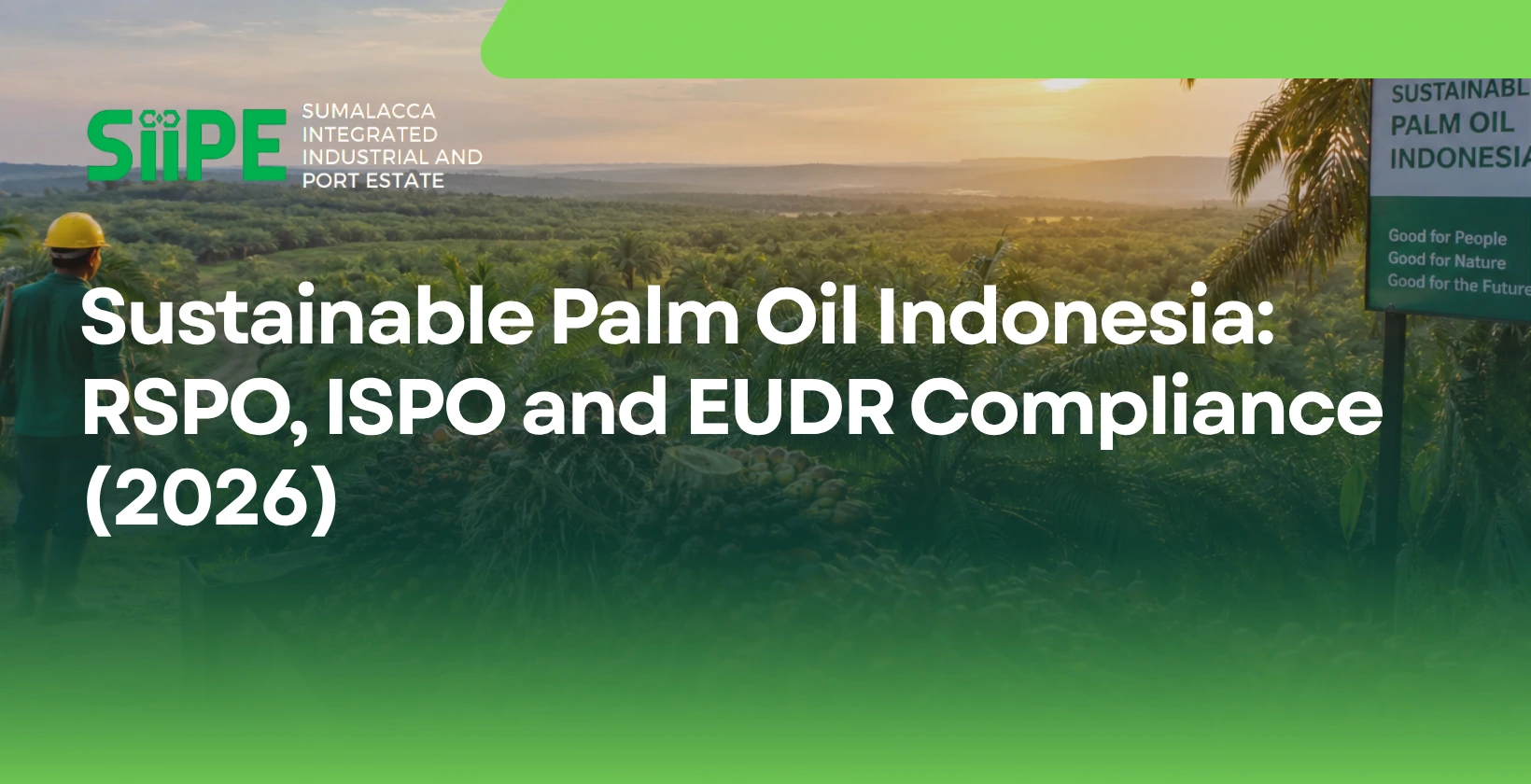
Sustainable palm oil Indonesia is now defined by three instruments that answer three different questions. ISPO asks whether a business complies with Indonesian law and good practice, and it is mandatory. RSPO asks whether oil meets a voluntary international standard that many multinational buyers write into their contracts. The EU Deforestation Regulation (EUDR) asks whether a specific product can legally enter the European market at all, and from 30 December 2026 it applies to large and medium operators.
A certificate under one does not answer the questions of the others. That is the part most guides skip, and it is the part that decides how a mill, a refinery or a tank terminal has to be designed.
This guide compares the three as they stand in 2026, with current certification figures, and sets out what traceability requires once oil leaves the plantation. We develop an estate in North Sumatra planned with palm oil processing as its first sector, so we pay particular attention to the refinery and terminal end of the chain.
Last updated: 25 September 2026
Sustainable Palm Oil Indonesia: Three Systems, Three Questions
Buyers, lenders and regulators use these three instruments for different decisions, so it helps to be precise about what each one is for before comparing them.
| ISPO | RSPO | EUDR | |
|---|---|---|---|
| Set by | Government of Indonesia | Roundtable on Sustainable Palm Oil Indonesia, a multi-stakeholder association | European Union |
| Legal status | Mandatory in Indonesia | Voluntary | Law for anyone placing palm products on the EU market |
| Current basis | Presidential Regulation No. 16 of 2025 | Principles and Criteria, revised in 2024 | Regulation (EU) 2023/1115 |
| What it proves | The business complies with Indonesian law and ISPO principles | The oil meets RSPO criteria, under a stated supply chain model | The product is deforestation-free, legal and covered by a due diligence statement |
| What is assessed | The business | The certified unit and its supply chain | Each product and the plots of land it came from |
The last row matters most. ISPO and RSPO certify operations. The EUDR tests products, back to the plot of land. An operation can be fully certified and still ship a parcel that fails the EUDR because one supplying plot cannot be located.
ISPO: Indonesia’s Mandatory Standard
ISPO (Indonesian Sustainable Palm Oil) is the national certification system and the legal floor for sustainable palm oil Indonesia. Since March 2025 it reaches well beyond the plantation. Presidential Regulation No. 16 of 2025 on the Indonesian sustainable palm oil certification system took effect on 19 March 2025 and revoked Presidential Regulation No. 44 of 2020.
The changes that matter downstream of the mill:
- Scope. Certification is now required for plantation businesses (cultivation, processing of plantation output, or both), for the downstream palm oil industry, and for palm oil bioenergy companies. The 2020 regulation covered plantations only.
- Principles. Plantations are assessed against seven principles: legal compliance; good plantation practice; management of the environment, natural resources and biodiversity; labour responsibility; social responsibility and community economic empowerment; transparency; and continuous improvement. Downstream industry and bioenergy are assessed against three: legal compliance, traceability, and continuous business improvement.
- Deadlines. The downstream and bioenergy obligations apply two years after promulgation, which is 19 March 2027. Smallholders have four years, to 19 March 2029.
- Continuity and sanctions. Certificates issued under the old regulation stay valid until they expire. Non-compliance carries administrative sanctions: written warnings, fines or temporary suspension of business activities.
Traceability as a named principle for refiners and bioenergy producers is the change to notice. From March 2027 a refinery in Indonesia will need to show where its oil came from to satisfy Indonesian law, not only a European customer.
Coverage today. According to the Coordinating Ministry for Economic Affairs, as reported by ANTARA, ISPO certificates had been issued by June 2026 to 909 companies covering 7.17 million hectares and to 144 smallholder entities covering 355,122 hectares. Counting only certificates still active, the figures fall to 767 companies with about 5.67 million hectares and 114 smallholder entities with 283,136 hectares.
The smallholder figure is the system’s weak point. Smallholders manage roughly 41% of Indonesia’s oil palm area, according to the Council of Palm Oil Producing Countries, yet they hold under 5% of the actively certified area. The ministry says it assumes all smallholders will be certified by 2029. Until that assumption is proven, the gap is a sourcing risk for any refiner buying from independent mills.
If you are planning a refinery, fractionation or oleochemical plant for export markets, traceability is now a design input rather than a paperwork exercise. Book an investor call and we will take you through the plots and the status of the port planned alongside them.
RSPO: The Voluntary Market Standard
RSPO (Roundtable on Sustainable Palm Oil) is voluntary, international, and the standard many multinational food, personal care and chemical buyers name in their sourcing policies. Its reach is large but far from universal.
According to the RSPO Impact Report 2026, 16.2 million tonnes of RSPO certified sustainable palm oil (CSPO) were sold in 2025, about 20% of global palm oil supply. RSPO member growers hold a certified capacity of 31.4 million tonnes, so only about half of the oil that could be sold as certified is actually sold that way. Membership stands at 6,280 across 103 countries and territories, and independent smallholders earned US$7.9 million from credit sales in 2025.
Two features separate RSPO from ISPO in practice:
- A no-deforestation test at the plantation. RSPO’s standard, revised and adopted in November 2024, expects an integrated High Conservation Value and High Carbon Stock (HCV-HCSA) assessment before land is cleared. Land cleared without one since 15 November 2018 falls under its remediation and compensation procedure.
- Supply chain models. RSPO certifies the chain after the mill as well as the plantation, and every certified sale carries a supply chain model that tells the buyer how physically separate the oil is. That model, more than the certificate itself, decides how useful the oil is for EUDR purposes.
For an exporter, RSPO is a commercial decision rather than a legal one. Its value is the set of customers whose sourcing policies require it, and the price of losing them.
RSPO vs ISPO Side by Side
The two systems overlap on legality and good practice and diverge on most of what a European buyer asks about. The comparison uses Presidential Regulation No. 16 of 2025 for ISPO and the 2024 standard for RSPO.
| Criterion | ISPO | RSPO |
|---|---|---|
| Deforestation | No deforestation-free cut-off in the principles; WWF-Indonesia calls this the main gap for EUDR use | HCV-HCSA assessment before clearing; remediation for clearing since 15 November 2018 |
| Downstream coverage | Refining and bioenergy mandatory from 19 March 2027 | Supply chain certification under four models |
| Smallholders | Mandatory by 19 March 2029 | Voluntary, with a separate independent smallholder standard and credits |
| Scale | Certificates issued for 7.52 million ha across 1,053 businesses (June 2026) | 16.2 million tonnes sold in 2025, about 20% of global supply |
| What it buys you | Licence to operate in Indonesia | Access to buyers whose policies require it |
ISPO is necessary for anyone operating in Indonesia, and RSPO for anyone selling to buyers who ask for it. Neither, on its own, is sufficient for the EU.
The EUDR: What Changes on 30 December 2026
The EU Deforestation Regulation, Regulation (EU) 2023/1115, is not a certification scheme. It is a market-access law, and for palm oil its core test is short to state and demanding to meet.
A palm product may be placed on the EU market, or exported from it, only if it is:
- Deforestation-free: produced on land not deforested after 31 December 2020. A forest, for this purpose, is land of more than 0.5 hectares with trees taller than 5 metres and canopy cover above 10%.
- Legal: produced in line with the relevant legislation of the country of production.
- Covered by a due diligence statement, which must include the geolocation of every plot of land that produced the commodity, with polygon boundaries for plots larger than 4 hectares.
Timing. The Council’s December 2025 revision set application at 30 December 2026 for large and medium operators and 30 June 2027 for micro and small operators, and required a simplification review by 30 April 2026. When the Commission published that review in May 2026, it confirmed there would be no further postponement.
What was simplified. Downstream operators and traders no longer file their own due diligence statements; they collect and keep the reference numbers issued to the operator that first placed the product on the market. Micro and small primary operators file a single simplified declaration. None of this lightens the first operator’s load: the company that first places Indonesian palm oil on the EU market still needs plot-level geolocation for every parcel.
Indonesia’s risk category. Under the Commission’s country benchmarking, adopted in Implementing Regulation (EU) 2025/1093 in May 2025, Indonesia is standard risk. Only four countries are high risk. Standard risk means full due diligence, with no simplified route for Indonesian palm oil.
Where the EU sits in Indonesia’s trade. The EU is a minority market. In January to April 2026 Indonesia shipped 1.70 million tonnes of palm oil to the EU, up 12.74% on the year and about 9.13% of its palm oil exports, according to the Trade Ministry. For scale, GAPKI puts 2025 exports at 32.34 million tonnes and crude palm oil production at 51.66 million tonnes. The EUDR governs a small share of Indonesian palm oil, but it is the share going to the buyers with the strictest requirements, and in early 2026 it was growing.
Our palm oil supply chain article walks through the EUDR traceability test stage by stage, from plantation to export terminal.
Supply Chain Models and What Each One Proves
Supply chain models describe how certified oil is handled after the mill, and they are where certification and the EUDR meet. RSPO defines four.
| Model | Kept apart from conventional oil? | Sources | EUDR fit, per RSPO guidance |
|---|---|---|---|
| Identity Preserved (IP) | Yes, throughout the chain | A single identifiable certified source | Supports compliance; the information travels with the oil |
| Segregated (SG) | Yes, throughout the chain | Several certified sources | Supports compliance; the information travels with the oil |
| Mass Balance (MB) | No, mixed with conventional oil | Several certified sources | Only if the non-certified share is proven legal and deforestation-free |
| RSPO Credits (book and claim) | No physical link | Certified growers, crushers and independent smallholders | Credits can still be traded, but the physical oil must comply on its own |
RSPO’s guidance on the EUDR is careful on one point: neither Identity Preserved nor Segregated is a formal assurance of EUDR compliance. They make compliance easier to demonstrate because the required information is already attached to the oil. As RSPO notes, the EUDR prohibits mixing compliant with non-compliant material, which is why conventional mass balance, the mixing of certified with non-certified oil, does not work for EU-bound parcels unless the uncertified share can pass the same test.
The consequence for Indonesian exporters is a split supply chain. One stream, segregated and geolocated, serves EU buyers and anyone else who asks for the same standard. A second stream, mass balance or conventional, serves markets that do not. Running both through one mill, refinery and terminal is possible, but only if the physical assets are designed to keep them apart.
What Traceability Requires at a Terminal
A terminal is where segregated supply chains most often break, because it is where oil from many mills meets shared tanks, shared pipelines and shared vessels. Keeping a segregated or EUDR-compliant stream intact through a tank farm comes down to four things.
- Dedicated or controlled tankage. Segregated oil needs tanks that hold only segregated oil, or a documented cleaning and inspection step before a tank changes grade. Mass balance oil can share tanks, with the certified volume tracked in the records.
- Controlled transfer lines. Pipelines, manifolds and hoses hold residue from the previous parcel. Line clearing between grades, and a record of what each line last carried, stop a small quantity of conventional oil from compromising a segregated parcel.
- Parcel-level records. Each receipt into a tank has to be linked to its supplying mills, and for EU-bound oil to the plot data behind those mills, so every outgoing parcel can be traced back through the tanks it passed through. RSPO’s prisma platform, launched in February 2025, lets members upload and trace EUDR-relevant information along the chain.
- Vessel loading plans. A tanker carries several parcels in separate cargo tanks, and the terminal’s loading records must show which shore tanks fed which ship tanks.
Each of these has a cost. Segregation lowers tank utilisation, because a half-empty segregated tank cannot be topped up with conventional oil, and it adds cleaning time, scheduling constraints and record-keeping. That cost is far lower when segregation is designed in, with more and smaller tanks, separate line routing and metering at every transfer, than when it is retrofitted into a tank farm built for a single grade. Our guide to bulk terminal operations explains how liquid bulk moves from the manifold to the tank farm.
What It Means for Processors Choosing a Site
For a refiner, fractionator or oleochemical producer, sustainable palm oil Indonesia comes down to three site questions. Can you source traceable oil nearby? Can you keep segregated streams apart through storage and loading? And how far does the oil travel between plant and berth, given that every transfer is another point where the chain can break?
SIIPE (Sumalacca Integrated Industrial and Port Estate) is a planned 5,600-hectare integrated industrial estate, deep seaport and township in Medan Belawan, North Sumatra. Around 840 hectares is acquired and the remaining 4,760 hectares still has to be acquired or reclaimed. The current development phase covers 3,000 hectares: 1,800 ha industrial estate, 400 ha deep seaport and 800 ha residential township. The site is 4.7 km from Belawan Port, about 10 minutes by road.
Crude palm oil and plantation processing is the first of the five sectors the estate is planned around, with plantation processing and refining plots under 5 km from the planned Sumalacca Dry & Liquid Bulk Port. A chemical storage tank facility and a jetty are on the estate’s planned infrastructure list, and capacities and operational status are not stated in the plan. None of this infrastructure is operational, and the port itself is a medium-term objective, so we quote no tank capacity, berth or throughput figure.
What that status offers a processor is timing. With storage and berth allocation still at the planning stage, segregation can be a design requirement rather than a retrofit, and now is the moment to state what your certified and conventional streams will need. Certification itself belongs to each operator; SIIPE does not hold, and cannot confer, ISPO or RSPO status on a tenant. The status of every component is set out on our Sumalacca Integrated Industrial and Port Estate page.
Frequently Asked Questions
What is sustainable palm oil Indonesia?
In Indonesia, sustainable palm oil is defined by two certification systems and one market law. ISPO is the mandatory national standard, RSPO is the voluntary international standard many multinational buyers require, and the EU Deforestation Regulation decides whether a product may enter the EU. Each tests something different, so exporters to Europe usually need to satisfy all three.
Is ISPO certification mandatory?
Yes. Under Presidential Regulation No. 16 of 2025, ISPO is mandatory for oil palm plantation businesses, the downstream palm oil industry and palm oil bioenergy companies. Downstream and bioenergy obligations apply from 19 March 2027, and smallholders must be certified by 19 March 2029. Non-compliance carries administrative sanctions, from written warnings to temporary suspension.
What is the difference between RSPO and ISPO?
ISPO is a mandatory government standard focused on legal compliance and good practice, now extended to refining and bioenergy. RSPO is a voluntary multi-stakeholder standard with a no-deforestation assessment and four supply chain models. In practice, ISPO is a licence to operate in Indonesia, while RSPO is a condition of sale for buyers whose sourcing policies require it.
Does RSPO or ISPO certification guarantee EUDR compliance?
No. Neither is a formal assurance of EUDR compliance. RSPO’s Identity Preserved and Segregated models make compliance easier to show, because the required information travels with the oil. WWF-Indonesia’s assessment is that ISPO would need an explicit deforestation-free requirement before it could support EUDR compliance on its own.
Can mass balance palm oil be sold into the EU?
Only with extra proof. The EUDR prohibits mixing compliant with non-compliant material, and RSPO Mass Balance mixes certified with non-certified oil. RSPO’s guidance is that Mass Balance can support EU sales only if the non-certified share is also shown to be legally produced and deforestation-free, with geolocation for every plot.
When does the EUDR apply to palm oil from Indonesia?
The EUDR applies from 30 December 2026 for large and medium operators and from 30 June 2027 for micro and small operators. In May 2026 the Commission confirmed there would be no further postponement. Indonesia is classified as standard risk, so operators must carry out full due diligence on the palm oil they place on the EU market.
Talk to SIIPE’s Investment Team
If you are planning refining, fractionation, oleochemical or biodiesel capacity for export markets, the decisions that make traceability affordable are made before the tanks are built. SIIPE is a planned 5,600-hectare estate in Medan Belawan with a current 3,000-hectare development phase, around 840 hectares acquired, and a site 4.7 km from Belawan Port. Its port and storage are planned rather than operational, and we will say so in every meeting.
Our investment team can walk you through plot options for plantation processing and refining, the planned port, and the status of each permit. Book an investor call through the enquiry form, or message us on WhatsApp at +62 811 860 980.